

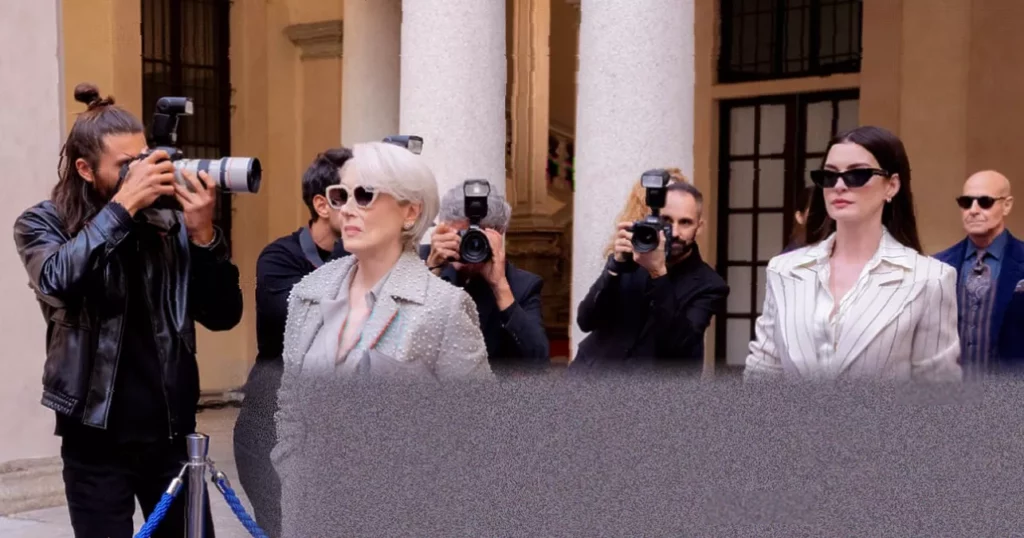
For weeks, Meryl Streep and Anne Hathaway talked up the body diversity they had fought to bring to The Devil Wears Prada sequel. Hathaway told interviewers she had made a “beeline to the producers” after being shocked by how “alarmingly thin” models were during Milan Fashion Week. Streep said they wanted to avoid featuring “skeletal” models. Yet just 15 minutes into the film, the first weight gag lands – and the promises are revealed as little more than size-washing.
Broken promises on screen
The sequel, released on 1 May 2026, reunites the original cast with new additions including Justin Theroux, Lucy Liu, Simone Ashley and Kenneth Branagh, and features a song titled “Runway” by Lady Gaga and Doechii. Despite grossing $50.5m against a $100m budget, the film has been accused of tokenism. Comedian Caleb Hearon appears as Miranda Priestly’s second assistant, and a brief catwalk montage includes plus-size model Ashley Graham – just enough, critics say, for producers to tick an inclusivity box.
Hathaway has since clarified that her intervention created more casting opportunities, saying “nobody lost their jobs, in fact, it created more jobs”. But the script still leans heavily on weight humour. Andy Sachs, played by Hathaway, reintroduces herself to Miranda as “your former fat assistant” – a callback to the first film, in which Miranda called her the “smart, fat girl”. In the original, Hathaway wore a padded size-6 bum prosthetic until her character’s “size-6 ass” dropped to a size 4. This time, Andy has kept the weight off for two decades while becoming an award-winning journalist. “Who says women can’t have it all?” the film seems to ask.
Later, Miranda becomes confused by the term “body positivity”. Puffing out her cheeks to exaggerate chubbiness, she calls it “body negative”, adding: “What is there to be positive about?” One review notes that although there is an “uptick in body diversity” compared with the original, the underlying messaging remains “rancid”, with jokes about fatness treated as inherently funny.
Fashion industry’s regression to thinness
The film’s approach mirrors a broader retreat from body inclusivity in fashion. For much of the 2010s, the industry appeared to be moving forward. In 2017, Ashley Graham became the first plus-size model on the cover of American Vogue. In 2020, Dutch model Jill Kortleve walked for Chanel – the first model above a UK size 8 to do so in a decade. Then, in April 2023, British Vogue put Kortleve alongside Paloma Elsesser and Precious Lee on its cover under the headline “The New Supers”, marking a high point for representation.
Yet only two years later, a model agency founder warned that the industry had “done a 360 turn” back to promoting thinness. A report by Vogue Business in March 2026 confirmed the shift: of 7,817 looks across 182 womenswear shows in February and March, 97.6% were shown on straight-size models (UK sizes 4-8). Just 0.3% were plus-size (UK 18+) and 2.1% were mid-size (UK 10-16). The retreat is not limited to luxury catwalks. A UK watchdog has urged retailers to avoid “irresponsible” images of unhealthily thin models. Some brands, including H&M, have removed dedicated plus-size sections from physical stores, making those ranges available only online.
Several factors have been identified as contributing to this reversal, from rightwing gender politics to changing ideals of the female body. But the most significant catalyst is the widespread adoption of weight-loss drugs, particularly GLP‑1 medications such as Ozempic. Originally developed to treat diabetes, these drugs have been co-opted for weight loss, especially in Hollywood. The debut issue of 72 magazine, edited by former British Vogue editor Edward Enninful – the same editor who put Kortleve, Elsesser and Lee on the cover – featured an unbranded GLP-1 injection pen in a beauty shoot.
Data from September 2025 indicates that about 23% of US households were using GLP‑1 medications. Around 80% of users anticipate needing new clothing as their size changes; 55% have already bought new clothes for this reason. This “body transformation economy” is disrupting the apparel industry. Plus-size retailers are reporting declining sales: Destination XL saw a 6% year-on-year drop, with its CEO attributing the fall to customers changing sizes due to drug use. Torrid reported a 14% sales decline in the fourth quarter of 2025 and closed 151 stores that year. Sales data from Manhattan shows that between 2022 and 2024, purchases of women’s button‑down shirts in sizes XXS, XS and S increased by 12%, while sales in XL and XXL dropped by 10.9%. A study has warned that US retailers are unprepared for the speed and scale of these body changes, risking billions in misaligned inventory and returns.
The Met Gala, held on 4 May 2026 with the theme “Fashion is Art”, is set to be a showcase for what many see as the new status symbol: a slender body rather than a designer outfit. The dress code asks guests to “express their own relationship to fashion as an embodied art form”, encouraging the kind of naked dressing that celebrates thinness.
A reflection of stagnant progress
Twenty years after the first The Devil Wears Prada film arrived at the height of noughties diet culture, when celebrities’ cellulite was circled and saggy knees mocked, the sequel’s weight jokes land with a grim familiarity. The film’s handling of body image is an accurate reflection of how little progress has been made off-screen. Miranda Priestly’s baffled dismissal of body positivity – “What is there to be positive about?” – might be intended as a punchline, but in a year when 97.6% of catwalk models are straight-size and the industry is reshaping itself to accommodate drug‑induced weight loss, it sounds less like a joke and more like a depressing statement of fact.