

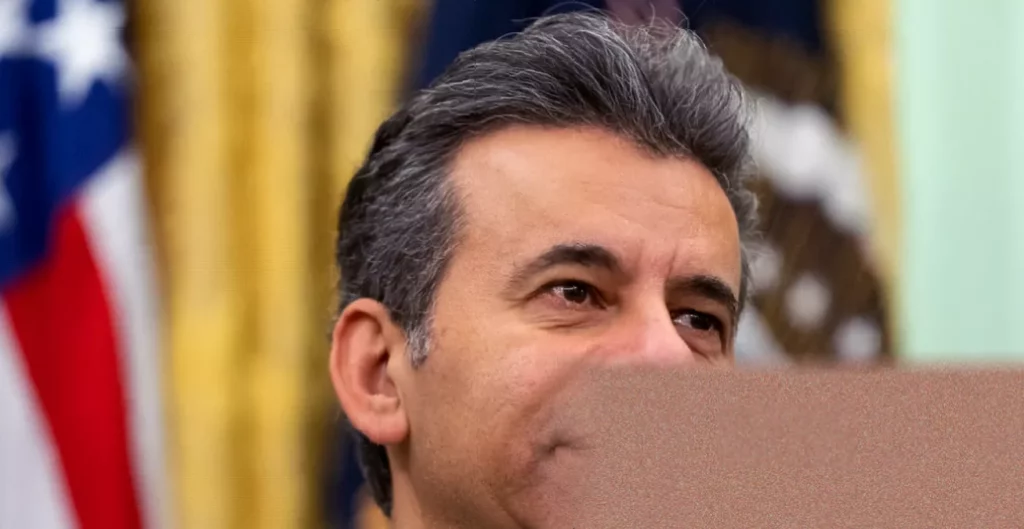
Marty Makary resigned as commissioner of the US Food and Drug Administration (FDA) on Tuesday, ending a 13-month tenure that repeatedly drew fire from the White House, Congress, industry and the public, Donald Trump confirmed.
Kyle Diamantas, the agency’s deputy commissioner for food who previously set strategic direction for US food policy, will serve as acting replacement. Trump called Diamantas a “very talented person” in a Truth Social post confirming the appointment. Makary’s resignation is one of the fastest commissioner departures in modern FDA history.
In a text shared by Trump, Makary wrote: “Please accept my resignation, effective today. During my tenure, I announced 50 major FDA reforms. Joe Biden’s FDA had none. I’m extremely proud that we have reduced drug review times from a year to 1-2 months, wrote new guidance to advance psychedelics, introduced a new ‘plausible mechanism’ pathway for rare disease drugs, and changed estrogen labels to tell women the truth about menopausal hormone replacement. It’s been the honor of a lifetime to serve as your FDA commissioner. I am forever grateful.”
Controversies and clashes that defined his tenure
The immediate catalyst for Makary’s departure was his resistance to approving fruit-flavoured vapes. Citing concerns about youth appeal and addiction, Makary initially overrode agency scientists to halt the approval of the first such products on the market. Trump reportedly scolded the FDA chief for the delay and signed off on a plan to fire Makary earlier this month, according to the Wall Street Journal. Last week, the FDA announced the approval would move forward, authorising some flavoured e-cigarettes for adults.
On Friday, when asked whether he would fire Makary, Trump replied: “He seems fine … I’ve been reading about it, but I know nothing about it.” On Tuesday, Trump told reporters Makary was “a great guy” but “was having some difficulty”.
Q: Did you ask Marty Makary to resign or fire him?
TRUMP: Well, I don't want to say, but Marty is a great guy. He was having some difficulty pic.twitter.com/YoFy78Lv9a
— Aaron Rupar (@atrupar) May 12, 2026
Makary also clashed with lawmakers over the abortion drug mifepristone. Conservative members of Congress accused him of slow-walking a review of the medication, despite abundant scientific evidence on its safety. Senator Josh Hawley accused Makary of being “uniquely destructive to the prolife movement”, alleging the commissioner had “used his discretion to approve a new abortion drug when the data shows it sends 1 in 10 women to the emergency room”. The Trump administration had announced a safety review of mifepristone, which advocates feared could lead to new limits on access. However, internal FDA documents reviewed by analysts showed the agency had historically taken a cautious, evidence-based approach to the drug’s regulation.
Senator Ron Johnson of Wisconsin launched an investigation into the FDA’s rejections of rare disease drug candidates, accusing the agency of “bureaucratic idiocy” and a pattern of saying “no” to potentially life-saving treatments. Johnson suggested he might call on senior FDA officials, including Makary, to testify. At a House ways and means committee budget hearing last month, Republican congressman Darin LaHood said the FDA’s “mismanagement and bungled drug reviews” had “chilled investments in life-saving, innovative cures”.
Vaccine policy became another flashpoint. The FDA halted the publication of research on the safety of shingles and COVID-19 vaccines, a decision that Janet Woodcock, former acting FDA commissioner, described as a “pattern” of “not letting information out that might support the general safety of vaccines”. The agency also refused to consider Moderna’s new flu vaccine, a decision that was reversed after public backlash. Within the “Make America Healthy Again” movement led by Health Secretary Robert F. Kennedy Jr., there was anger over Makary’s approval of updated mRNA COVID-19 vaccines for low-risk groups. The Trump administration has since shied away from discussing its unpopular changes to routine vaccine recommendations before the midterm elections.
“Vaccines have really gotten their attention,” said Peter Lurie, executive director of the Center for Science in the Public Interest and a former associate FDA commissioner. “They do understand that they’ve gone too far for the American people on vaccines.”
Beyond specific policy fights, Makary’s leadership was marked by organisational upheaval. Waves of layoffs and the appointment of inexperienced officials created what Lurie called a “massive upheaval that has been an ongoing feature of daily work at FDA ever since the new administration began. It’s just endless chaos.” Some reports indicated senior White House and health department officials had agreed on the need for new leadership to stabilise the agency. Concerns also mounted over revamped clinical trial guidelines, the commissioner’s new priority review vouchers, and “data-free” regulatory decisions.
This is welcome news. Dr. Makary was uniquely destructive to the prolife movement. He attempted to place pro-abortion lawyers in key positions. He slow walked a vitally necessary review of the abortion drug mifepristone. He used his discretion to approve a new abortion drug when… https://t.co/ZHn5UsImeW
— Josh Hawley (@HawleyMO) May 12, 2026
Reactions from across the political spectrum
Senator Josh Hawley called Makary’s resignation “welcome news”, writing on X: “Dr Makary was uniquely destructive to the prolife movement. He attempted to place pro-abortion lawyers in key positions. He slow walked a vitally necessary review of the abortion drug mifepristone. … He froze out prolife leaders and repeatedly stonewalled Congress. His resignation is an opportunity for the FDA to reset.”
Senator Dick Durbin, the Democratic whip, celebrated Makary’s departure for a contrasting reason. He said he had voted for Makary based on the commissioner’s commitment to say “no” if Trump asked him to do something that would harm America. “Dr Makary kept his word. He resisted Trump’s plan to expose millions of children to the dangers of vaping. I hope Dr Makary will inspire others within the Trump Administration to grow a spine and put the families of America ahead of blind loyalty to this president.”
Senator Ron Johnson, who had pressed Makary on rare disease approvals, said the former commissioner was “saying all the right things, but his agency continues to say no”. Johnson suggested Makary should have started overruling his researchers.
President Trump thanked Makary for his service on Truth Social, writing that “so much was accomplished under his leadership. He was a hard worker, who was respected by all, and will go on to have an outstanding career in Medicine.”
Meanwhile, several key health posts in the Trump administration remain unfilled. Nicole Saphier, Trump’s third pick for US surgeon general, and Erica Schwartz, the fifth nominee in the past year to lead the Centers for Disease Control and Prevention (CDC), have yet to undergo Senate confirmation. Saphier, a radiologist and former Fox News contributor, has previously questioned routine childhood vaccines. Schwartz is a former deputy surgeon general. Jay Bhattacharya, confirmed as director of the National Institutes of Health in March 2025 and a critic of the government’s COVID-19 response, is currently serving as acting CDC director.