

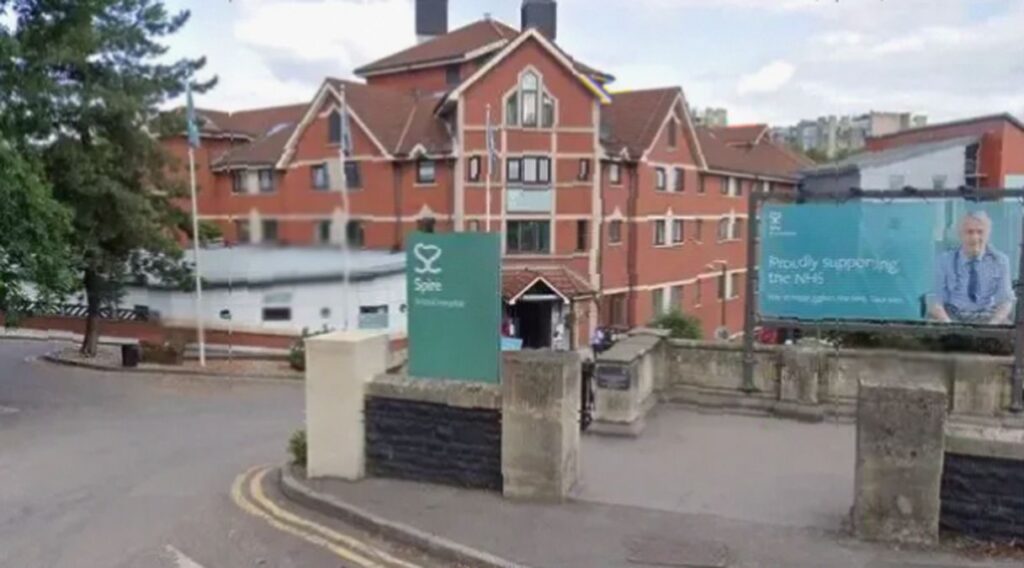
A mother has described her “sickening” discovery that bone material from a deceased donor was grafted into her daughter’s mouth during cleft palate surgery without her knowledge or consent, a revelation that came months after the operation when the family was told the procedure had failed.
The Somerset family had waited two years for NHS treatment before the girl’s second bone graft operation was outsourced to Spire Bristol Hospital in December 2024, where a retired surgeon performed the surgery. The agreed surgical plan, the mother said, involved harvesting bone from the child’s knee and grafting it into her mouth – a standard approach in cleft palate repair. Instead, the surgeon used a compound containing demineralised bone fibre derived from cadaveric bone, mixed with a small quantity of the patient’s own jawbone.
The consent form signed by the mother made no reference to cadaveric material. “I found the whole incident with the cadaver bone utterly shocking, really sickening,” she said. “When my daughter and I were in a meeting where we found out the second bone graft had also failed, the way the surgeon looked when she was looking through the medical notes was really concerning, she looked horrified. I had to ask what was going on, and when she told me, I was utterly shocked. My daughter was there so I didn’t want to react too much, but I was furious, sickened, I just couldn’t believe it. We had not given consent for this, we knew nothing about it.”
Why the use of cadaver bone without consent is a significant issue
The use of human tissue from a deceased person in surgery is governed in the UK by the Human Tissue Act 2004, which requires that consent must be obtained from an “appropriate person” for all “scheduled purposes” including medical treatment. The act does not mandate written consent for all purposes, but consent must be a positive act given by an appropriately informed individual. In this case, the mother signed a consent form that made no mention of cadaveric material, meaning the family was never given the opportunity to consider or agree to the use of deceased donor tissue in their child’s body.
The material used – demineralised bone fibre – is a product derived from the bone of deceased donors. It is described by Spire Healthcare as having a structure resembling cotton wool and is used as a type of filler to pack gaps in surgical repairs. It is a medical product used in many surgeries including dental surgery, neurosurgery and orthopaedic surgery. However, Spire Healthcare itself confirmed that the procedure was not a structural cadaveric bone graft, but rather a compound containing cadaveric bone fibre mixed with a small quantity of the patient’s own jawbone.
Experts have raised concerns about the appropriateness of this approach in a revisional cleft palate procedure. One consultant, speaking anonymously, told the BBC: “As it is a revisional procedure, extra care should have been taken to ensure a successful outcome – a ‘non standard’ treatment with (this compound) alone was not appropriate.” Another consultant noted that synthetic bone materials simply do not produce results comparable to those of the patient’s own bone.
Owen Lake, a solicitor at Slater and Gordon representing the family, said initial evidence suggests approximately 12 children underwent treatment by the same surgeon during the outsourcing period. He stated: “It’s not UK standard practice to use cadaveric bone in this instance.” Both Spire Healthcare and University Hospitals Bristol and Weston NHS Foundation Trust refused to comment on patient numbers.
The daughter herself noticed something was wrong immediately after waking from anaesthesia. “I was surprised when I came out of being asleep because I was meant to be having part of the bone taken out of my knee yet I could walk fine,” she told the BBC.
Hospital responses and broader service concerns
Spire Healthcare issued an apology, saying: “We are sorry for any distress caused to this patient and an apology has been provided to the family. Any patients who have concerns about the South West Cleft Service (SWCS) should contact the University Hospitals Bristol and Weston NHS Foundation Trust.”
Dr Rebecca Maxwell, medical director at University Hospitals Bristol and Weston NHS Foundation Trust, said: “We can confirm that pieces of cadaveric bone are not used in cleft palate surgery in the South West Cleft Service. We absolutely recognise our failure to clearly explain decisions around the surgery which were made in good faith with the best interests of this young person at heart, and we are sincerely sorry for any distress caused. We understand that it can be difficult for any family whose child requires hospital care and acknowledge we could have done more to support this family through this challenging time. We would like to reiterate our apology for the concern caused to the family and will continue to work with them through their treatment journey.”
The case emerges amid broader concerns about the South West Cleft Service, which is based at University Hospitals Bristol and Weston NHS Trust and is one of nine national cleft centres in England, providing surgery, psychology, speech therapy, dental and orthodontic care with outreach clinics across the region. A review of 268 patients awaiting treatment between 2020 and 2022 revealed that 118 suffered some degree of harm due to delays. Two patients experienced “severe” harm, including tooth loss and decay. A 2022 report identified contributing factors including insufficient theatre capacity, stretched speech and language therapy teams, and prolonged staff illness. The COVID-19 pandemic significantly reduced theatre capacity for the cleft service, leading to backlogs, although paediatric backlogs were partially mitigated by satellite operating and additional lists, with discussions held with the Children’s Hospital in Cardiff to treat eleven patients between March and May 2021.
Spire Healthcare has faced previous scrutiny over patient care. In April 2021, it was fined £5,000 for failing to apologise or disclose details of treatment failures to four patients in a timely manner, relating to surgical procedures by consultant Mike Walsh. In September 2023, a former patient of discredited surgeon Anthony Dixon at Spire Bristol Hospital alleged he performed unnecessary and invasive surgery without consent; a review found over 200 patients may have undergone unnecessary mesh bowel operations. In July 2023, spinal orthopaedic surgeon John (Mervyn) Hutchinson, who practised at Spire Bristol Hospital, faced allegations of misconduct and dishonesty, with his practising privileges revoked in 2019 and conditions imposed on his GMC licence. In May 2024, Spire Healthcare announced an extended patient recall for procedures performed by spinal surgeon John Bradley Williamson between 1998 and 2013. The retired surgeon who performed the December 2024 cleft procedure at Spire Bristol Hospital has not been named.
Cleft palate treatment requires highly specialised care, and delays or complications can affect a child’s speech development, eating ability and physical appearance for life. The South West Cleft Service provides a dedicated cleft psychology service offering advice and support for patients and families on issues such as preparing for surgery, dealing with external attitudes, anxiety, appearance concerns and family tensions. Bone donated by other patients, kept in a “bone bank” and mainly obtained from patients undergoing hip replacements or from deceased individuals, undergoes rigorous donor screening for diseases including HIV, HTLV, syphilis and hepatitis B and C, though there is no known test to detect vCJD, meaning a small risk of infection remains. All activities related to bone donation are licensed by the Human Tissue Authority.