

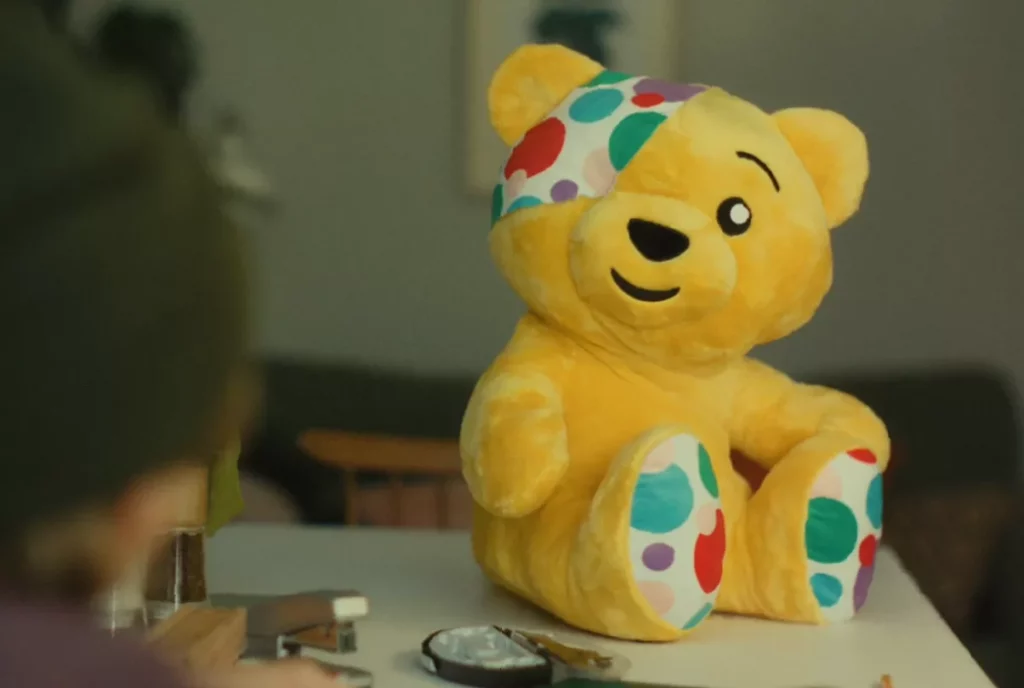
For more than four decades, Pudsey Bear has stood alongside children without uttering a word. Now, for the first time, the mascot of BBC Children In Need is speaking — and his message is directed squarely at the adults who might be struggling to know what to say back.
The 30-second film, titled Pudsey Finds His Voice, marks the first time the iconic yellow bear has been given spoken dialogue in the charity’s history. In it, he holds a conversation with actor Dexter Sol Ansell, delivering a central plea: “Every child deserves an adult who will listen.” The advert premiered on BBC One’s The One Show at 7pm on Monday and is set to air across BBC television and radio. It was co-produced by BBC Creative and Blinkink.
The reason for breaking Pudsey’s silence is stark. Research commissioned by BBC Children In Need from Censuswide found that nearly a quarter of children — 24% — keep their worries to themselves. More than a third (38%) said their worries had made life less enjoyable or caused them to stay silent because of fear or embarrassment. Yet children who do have someone to talk to are around nine times more likely to report feeling happy.
Claire Hoyle, interim chief executive at BBC Children In Need, said: “It’s on all of us to create the moments, ask the questions, and really listen.” The campaign’s core message urges adults to “take responsibility for children’s mental health” by helping young people vocalise worries, concerns and feelings.
Alongside the film, the charity has announced a £1.24 million investment in mental health support for children and young people, to be distributed to organisations including Mental Health Innovations and The Children’s Society.
Why so many children — and adults — struggle to speak
The campaign lands against a backdrop of deepening mental health difficulties among young people in the UK. In 2023, 20% of children aged eight to 16 in England had a probable mental disorder. Among those aged 17 to 19, the figure rose to 23%. Globally, more than one in seven adolescents aged 10 to 19 are living with a diagnosed mental health condition. Half of all mental health conditions start before the age of 14, yet many go undetected and untreated.
The system meant to help them is under severe strain. In 2022-23, nearly one million children and young people in England were referred to Child and Adolescent Mental Health Services (CAMHS). Of those, 28% (270,300) were still waiting for support, and 39% had their referral closed before they ever accessed it. By November 2023, 445,000 people were in contact with children’s mental health services in England — almost double the 231,000 recorded in November 2019. Despite this rise, an estimated fewer than 15% of children and families living in poverty who need mental health support actually receive it.
Adults, meanwhile, often lack the confidence or tools to start these conversations. The NSPCC provides resources for parents on how to talk to children about feelings. BBC Children In Need itself has developed “Pudsey’s Pause”, a three-step tool — pause, spot, share — designed to help parents teach children to articulate what they are going through. The Government is rolling out Mental Health Support Teams (MHSTs) in schools, aiming to cover at least 50% of pupils by March 2025, and more than 15,000 schools and colleges have claimed grants to train Senior Mental Health Leads.
Yet early intervention remains critical. Programmes such as Action For Children’s “The Blues Programme”, which helps young people aged 13 to 19 manage low mood and anxious thoughts, reports 76% of participants showing improved mental wellbeing. The charity itself acknowledges that “too many children across the UK are facing life’s toughest moments alone” — with poverty, mental health struggles and grief among the issues. Currently, only one in six organisations that seek funding from BBC Children In Need can be supported.
Pudsey’s own story — and the history he carries
Pudsey Bear was created by BBC graphic designer Joanna Lane and first appeared in 1985. He was named after her hometown, Pudsey, in West Yorkshire — a name deliberately chosen to be easy for children with speech impediments or learning difficulties to pronounce and spell. Initially brown with a red bandana, he was redesigned in 1986 with yellow fur and a white-and-red bandana, and later gained a multicoloured bandana in 2007.
The charity he represents has its own long pedigree. The BBC’s involvement in charity appeals began with a five-minute radio broadcast on Christmas Day 1927, which raised £1,143 for four children’s charities. The first televised appeal — the “Children’s Hour Christmas Appeal” in 1955 — featured Sooty and Harry Corbett. The modern BBC Children In Need appeal launched in 1980 with a telethon format presented by Terry Wogan, Sue Lawley and Esther Rantzen, raising £1 million. Since then, the organisation has raised more than £1 billion. The 2025 appeal alone raised £45.5 million, with the live telethon now a three-hour programme broadcast on the third Friday of November.
Corporate partners including Asda, McDonald’s, One Stop, Greggs, Enterprise and Cineworld have provided longstanding support. And later this year, in December 2025, CBeebies and BBC One will air Pudsey and the Thread of Hope, a 25-minute animation based on a story by Tom Fletcher, following a young boy navigating grief with Pudsey’s help.
For now, however, the focus is on those everyday moments of silence — the worries a child holds, and the adult who may not know how to begin asking. Pudsey’s new voice is a reminder that the hardest conversation can start with just a few words.