

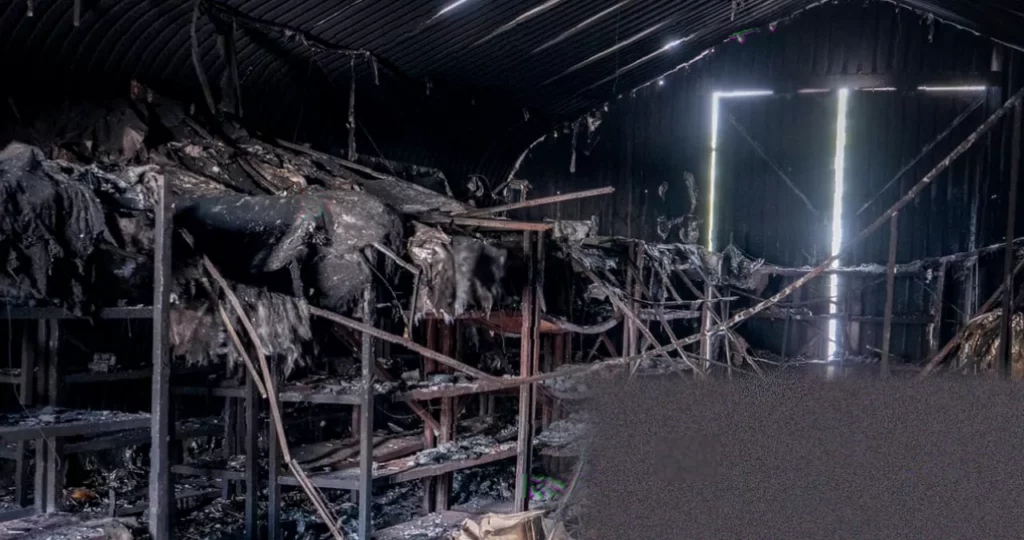
Médecins Sans Frontières has permanently closed its hospital in Lankien, South Sudan, after it was bombed, looted, and burned in a sustained attack that has left a region of a quarter of a million people without any secondary healthcare. The 80-bed facility – the only one of its kind in Nyirol county, Jonglei state – was reduced to a bombed-out shell in an airstrike on the evening of 3 February 2026, followed days later by a ground assault and systematic destruction that MSF has described as arson.
The hospital had been run by MSF for more than three decades, offering life-saving maternal and paediatric services, treatment for chronic diseases, severe malnutrition and malaria, and care for survivors of sexual violence. “It’s all gone,” said Yashovardhan, MSF’s head of mission, after the organisation’s first visit to the site in late April. The team found the premises littered with medical supplies and documents. Air conditioners, printers and oxygen concentrators had been thrown around and ripped apart. Electric panels had been smashed open and stripped of components. Not a single bed, chair or desk remained in the wards. Three of the five MSF vehicles had been stolen; the two that were left were riddled with bullets, their engines and seats missing. The cold-chain room, a large metal warehouse, had been completely burnt, its supplies turned to ash. “This is arson,” said Ben Greenacre, MSF’s humanitarian affairs manager. “People went in and purposely set it on fire.”
The attack began hours after MSF evacuated the site. According to a local MSF employee, the organisation decided to leave after receiving reports of imminent military operations. “It was on 3 February. It was a day of shock. Discharging patients, who were on beds for two, three weeks, a month … was very tough,” the employee, identified only as John, said. “By the afternoon we had managed to discharge our 48 patients, including 26 with gunshot wounds. At 6pm we closed the hospital and left. Then at around 7.30pm the airstrike came and hit our medical store.” A bomb dropped on the store caused the ground underneath to collapse, leaving a giant jagged crater in the middle of the hospital compound. One MSF staff member suffered minor injuries.
When government forces began a ground assault on 7 February, Lankien’s 20,000 residents fled into the surrounding bush. Not everyone made it. “We heard that people who were not able to run away, like the elderly and the youths with mental health problems, who drink alcohol, were killed in the market,” John said. The hospital was ransacked in the days that followed. MSF says it cannot establish with certainty who was responsible for the looting and vandalism. But a local man named Samson, who watched MSF staff inspect the charred remains of refrigerated stores, said: “I ran away when the SSPDF captured the town. I didn’t see the burning. But it was happening when the SSPDF had taken control.”
The destruction was deliberate and total, Yashovardhan stressed. “The hospital has been bombed, looted, burned; and whatever was left behind was vandalised. It was purposely done so that we would have no other choice but to close it down for good.” Six days after its assessment visit, MSF announced the permanent closure of the Lankien hospital – the fourth MSF hospital forced to shut in South Sudan since the beginning of 2025. In its statement, the organisation said the attack was “part of a wider and deeply worrying trend of violence against healthcare in South Sudan”. The closure came a year after MSF denounced the deliberate bombing of its hospital in Old Fangak, also in Jonglei, which killed seven people.
Community scattered and starved
The thousands of people displaced from Lankien in February sought refuge in Nyirol county’s swampy forests, surviving on leaves and wild fruit. In April, the resumption of food aid by the World Food Programme (WFP) motivated some to return to the town. There they were confronted with scenes of devastation: burnt tukuls, destroyed crops, damaged boreholes, no hospital and no market. “I saw the plane that came and bombed our hospital with my own eyes,” said Nyakeda, a deaf woman using sign language, who had been back for a week. “The situation is worsening. There’s no medication in the area. We are suffering.”
Hoth Majok, 28, who returned on 1 April, was rebuilding his shop among the scorched corrugated iron where the market once stood. “My shop and my home were destroyed, looted and burned,” he said. “Once commodities are brought to the market, the community will return.” The WFP had stopped food distribution in Lankien by the end of April. Around the same time, the WFP and other UN agencies warned of “a credible risk of famine” in four counties, with conflict-affected communities “cut off from food, markets, and essential services”. Mid-year food insecurity projections showed that 7.8 million South Sudanese – 55% of the population – would face high levels of severe food insecurity between April and July. “Acute malnutrition is being exacerbated by lack of access to health and nutrition services where facilities have been damaged or closed due to conflict,” the agencies said.
Nyanchiow Mabil, 35, had come from Nyatim, a displacement site blocked from receiving aid by the central government and local authorities, where MSF reported 58 people had died from suspected hunger in March. “I’m very sad about all this. Now I’ve returned to try to resettle, but we’re still lacking food and medicine,” she said. “Those who forced us to live in this horrible situation … who broke our borehole, burned down our hospital and our market … As women and mothers, we urge them not to ever return to Lankien.” Other women crowded around her and loudly agreed.
Conflict on the brink of civil war
The destruction of the MSF hospital took place within a broader military offensive called Operation Enduring Peace, launched by the South Sudan People’s Defence Forces (SSPDF) in mid-January 2026. The SSPDF aimed to recapture territories from the Sudan People’s Liberation Movement In Opposition (SPLM-IO), the group led by the now-suspended vice-president, Riek Machar. The SPLM-IO, in coordination with the Nuer youth militia known as the White Army, had captured several government outposts in northern Jonglei since December 2025. The SSPDF mounted its counteroffensive with aerial bombardments and ground assaults, hoping to dislodge the opposition from strongholds including Lankien.
The security situation across South Sudan deteriorated throughout 2025 as the 2018 peace agreement unravelled. In March 2025, Machar was placed under house arrest in Juba, accused of orchestrating an attack on a government garrison in the north-east. His arrest prompted his party to declare the peace agreement abrogated. The UN warned that South Sudan was on the brink of civil war and called on all parties to uphold the 2018 Revitalized Agreement on the Resolution of the Conflict in South Sudan. Elections originally due in December 2024 have been postponed to December 2026.
The human cost has been staggering. The UN estimates that more than 304,000 people in Jonglei have been displaced since December 2025. “Civilians are bearing the brunt of a spike in indiscriminate attacks, including aerial bombardments, deliberate killings, abductions and conflict-related sexual violence,” said Volker Türk, the UN high commissioner for human rights, in late February. He noted that on both sides, “troops have demonstrated a near total disregard for civilian protection.” According to the UN humanitarian agency, UNOCHA, 33 health facilities have been either looted or destroyed in Jonglei, leaving 1.4 million people with no access to healthcare. The health system is stretched to breaking point, with chronic shortages of medicine and staff, and an estimated 2.2 million children aged 6–59 months requiring treatment for acute malnutrition.
At the airstrip in Lankien on the day of the MSF team’s visit, traditional chiefs in uniforms and red sashes led a small crowd to welcome the visitors. Women wearing colourful lawas sang and danced, an oddly cheerful performance amid the ruins. But the scene could not mask the reality of a town stripped of its only hospital, its market, its boreholes and its crops. “There is a crater in the middle of the hospital,” Yashovardhan said, as if it were hard to believe. “It was purposely done so that we would have no other choice but to close it down for good.”