

Close Menu
    Useful
    • About Us
    • Contact Us
    • Advertise With Us
    • Health Explainers
    • Our Editorial Team
    Facebook
    HealthNewsDaily.co.uk
    • Home
    • NHS

      Muslim NHS worker in line for £25,000 after trans women permitted in women’s toilets

      14 May 2026

      South Sudan hospital, bustling on Monday morning, reduced to rubble by Tuesday night

      13 May 2026

      Mother outraged as NHS uses dead person’s bone in daughter’s mouth without consent

      12 May 2026

      Over 6,000 children in England seen at obesity clinics, new figures indicate

      12 May 2026

      Cancer diagnosis via NHS app and phone call denounced as major duty of care failure

      10 May 2026
    • Health Policy

      Families back comprehensive and wide-ranging review of Sussex maternity failings

      13 May 2026

      Father takes legal action against NHS in High Court over transgender teen’s hormone treatment

      13 May 2026

      Health records: a powerful boon for medicine but also a grave risk

      13 May 2026

      Marty Makary leaves FDA following dispute with Trump on fruit-flavoured vapes

      12 May 2026

      More than 10 million Britons off sick as UK absence crisis hits

      12 May 2026
    • Mental Health

      Woman sectioned after suspecting mother-in-law of poisoning her

      13 May 2026

      Pudsey Bear to speak out for Children In Need mental health campaign

      11 May 2026

      Woman’s eating disorders aggravated by husband’s weight loss, Annalisa Barbieri column

      10 May 2026

      Tuppence Middleton admits watching Naked Attraction in partner’s absence

      9 May 2026

      Many who thought cannabis could not cause dependence discover they were wrong

      9 May 2026
    • Wellness & Lifestyle

      Fibre supplement could bring gut back to normal for constipation sufferers

      14 May 2026

      Doctors reveal the optimal time of day to go to the loo

      12 May 2026

      Sound baths’ claimed ability to calm the nervous system questioned

      12 May 2026

      Mother insists chemical pregnancy is a real baby

      12 May 2026

      Pull-ups: challenging yet impressive – a guide to starting

      11 May 2026
    • Disease & Prevention

      Norovirus outbreak detains hundreds of UK passengers aboard berthed cruise ship

      13 May 2026

      Mother diagnosed with condition after baby daughter dies 48 hours after birth

      13 May 2026

      Passenger offers inside view of quarantine unit after cruise ship hantavirus outbreak

      13 May 2026

      Student nurse, 21, describes immediate impact of cancer diagnosis on her life

      12 May 2026

      Hundreds of thousands of infants to undergo SMA checks under new study

      12 May 2026
    • Treatment & Research

      After Jesy Nelson campaign, NHS expands SMA treatments to hundreds more children

      14 May 2026

      59,000-year-old tooth shows Neanderthals performed dental drilling with stone implements

      13 May 2026

      2025 marks third consecutive decrease in US overdose fatalities

      13 May 2026

      Some nations see obesity rates flatten or decline, study suggests

      13 May 2026

      UK lifts can no longer accommodate heavier Britons

      13 May 2026
    HealthNewsDaily.co.uk
    • NHS
    • Health Policy
    • Mental Health
    • Wellness & Lifestyle
    • Disease & Prevention
    • Treatment & Research
    Home » Wellness & Lifestyle » Running alters female physique in ways distinct from male
    Wellness & Lifestyle

    Running alters female physique in ways distinct from male

    Oliver MarshBy Oliver Marsh25 April 2026
    Runners crossing Tower Bridge during the London Marathon

    When the first women were finally allowed to run marathons in the 1980s, they faced more than just the physical challenge of 26.2 miles. Skeptics had warned that the distance would be too gruelling for the female body — and some went further, claiming it could damage a woman’s reproductive organs. Those fears, rooted in outdated notions rather than evidence, were quickly shown to be baseless once women began crossing finish lines. This Sunday, nearly 60,000 people will take on the London Marathon, and based on recent years almost half of them will be women.

    From scepticism to record entries

    The London Marathon launched in 1981, a time when women’s participation in long-distance running was still a novelty. By 2024, the event had grown so popular that more than half a million people entered the ballot for places — a world record for marathon applications. Of the 53,723 who finished last year, 42 per cent were female and 58 per cent male. The field is also getting younger again after a decade-long shift toward older runners; the 2024 marathon saw a slight increase in the proportion of entrants under 40.

    The idea that women could not handle the distance was disproved almost as soon as they were allowed to race. Yet physiological differences between the sexes do explain why men tend to finish faster. In last year’s London Marathon, the average finishing time for men was four hours and 12 minutes, while women averaged four hours and 49 minutes — a gap of 37 minutes. In 2022 the difference was similar: men averaged 4:21, women 4:57. The gap narrows among elite runners, but on average women also slow down slightly less than men between the first and second halves of the race.

    Anatomy of the stride: the Q angle and its consequences

    Much of the difference in running gait comes down to skeletal structure. Men are, on average, 9 per cent taller than women, but their legs are proportionally even longer. Yann Kai Oh, a running researcher at Leeds Beckett University, explains that women’s thighs are 12 per cent shorter than men’s, while their torsos are longer. “Men’s legs are longer and women have a longer torso in general,” Oh said.

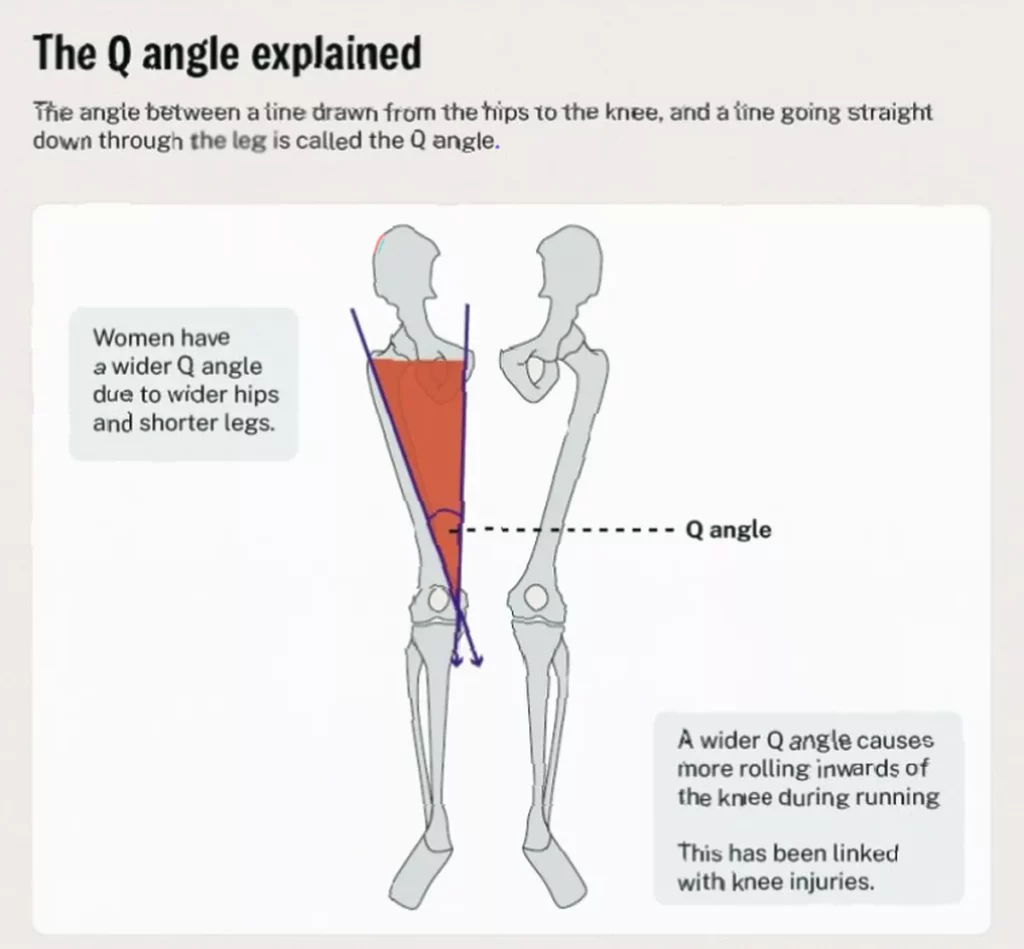
    The most important anatomical distinction for runners, however, involves the hips and legs. A line drawn straight down the thigh from the hip to the knee forms one angle with a line from the outside of the hip to the knee. This is called the Q angle, and it is wider in women — about 17 degrees, compared with 14 degrees in men. The reason is that women have wider hips, shaped for childbirth, combined with shorter legs.

    A wider Q angle changes the way the body absorbs impact during running. Video analysis shows that it causes the knees to roll inwards when the foot strikes the ground, creating a knock-kneed appearance. Dr Philip Nagy, a biomechanist at Lancaster University, says this alignment puts extra stress on the knee joint. “That knock-kneed alignment creates greater forces on the knee,” he explained. Studies have found that runners of either sex with wider Q angles are more prone to knee injuries, and female runners sustain more knee injuries than male runners overall.

    The wider Q angle also affects the foot. It tends to make the foot roll inwards on landing — a gait known as overpronation — which can increase the risk of foot and ankle injuries. Many running shoes are designed to correct overpronation with extra cushioning on the inner sole, while other shoes support underpronation (where the foot rolls outwards). Although some experts now question whether such corrections are necessary, Dr Nagy believes limited support can help, provided the shoes “still allow the feet to move naturally”.

    Close-up of a woman’s feet in motion showing overpronation

    Beyond the Q angle, female runners exhibit distinct lower-limb biomechanics. Research shows they have greater hip flexion, adduction and internal rotation angles, along with smaller knee flexion angles, compared with male runners. During the stance phase of running, women tend to have less knee flexion and more knee valgus — the knock-kneed position — and may have lower hamstring activation, which can increase the load on the anterior cruciate ligament (ACL). This helps explain why women are two to eight times more likely than men to suffer ACL injuries. Knee injuries account for 40 per cent of all injuries in female runners, compared with 31 per cent in men, and patellofemoral pain syndrome is also more common in women.

    Periods, hydration and other health risks

    The menstrual cycle can also affect performance and injury risk, though the evidence is mixed. Many female athletes report feeling worse during certain phases, particularly the early follicular and late luteal stages, but objective measures often show inconsistent effects. Some studies suggest reduced performance in the late luteal phase due to decreased neuromuscular efficiency, while others indicate improved endurance in the follicular phase because of greater carbohydrate utilisation. Hormonal fluctuations in oestrogen and progesterone can influence mood, motivation and energy availability. The impact varies widely between individuals, making cycle tracking important. On race day, period pain is unlikely to help anyone, and hormonal shifts may also affect collagen elasticity in the knee, potentially raising the risk of ACL injuries.

    A more concrete danger — and one women are more vulnerable to — is drinking too much fluid during a marathon. Overhydration can cause sodium levels in the blood to fall dangerously low, leading to confusion, seizures and even death. Women are at higher risk because they tend to be smaller, have lower total body water and smaller extracellular fluid volumes, and often take longer to finish the race, giving them more opportunities to drink. Research shows that risk factors include gaining substantial weight during the race, consuming more than three litres of fluids, drinking at every water station and having a low body mass index. Losing less than 0.75 kg of body weight during a marathon increases the risk of hyponatremia seven-fold.

    Until about a decade ago, common advice was to drink at every water station. That changed after marathon deaths attributed to overhydration. Dr Richard Blagrove, a sports scientist at Loughborough University, now advises runners to drink enough to quench their thirst. “Most people will definitely need to take on board fluids during the marathon,” he said. “But if people are forcing a lot of fluid down them, particularly in the early stages, that’s not necessarily a good thing.”

    Strength training can reduce the risk of injury for both men and women. Dr Nagy noted that “the difficulty for runners is finding time to do the strength training, if they’re running 50 kilometres a week.” For female runners, targeting the hips and glutes is especially important, as weak glutes and hip abductors are linked to conditions such as IT band syndrome and runner’s knee. Recommended exercises include squats, deadlifts, lunges, push-ups, rows, planks, glute bridges and calf raises, with two to three strength sessions per week. Postpartum runners may also need to focus on pelvic floor and core strengthening.

    Hydration Stress
    Share. Facebook Twitter LinkedIn WhatsApp Telegram
    Oliver Marsh
    Oliver Marsh

    Mental Health & Lifestyle Correspondent
    Oliver Marsh reports on mental health and wellness for Health News Daily. He covers NHS mental health services, workplace wellbeing, children's mental health, anxiety, depression and modern approaches to healthy living. A certified Mental Health First Aider, Oliver is passionate about breaking the stigma around mental health and making evidence-based wellbeing advice accessible to all. His reporting bridges the gap between clinical mental health news and practical lifestyle guidance for UK readers.
    · Certified Mental Health First Aider (MHFA England), peer support volunteer, lived experience of NHS Talking Therapies pathway
    · ADHD and autism in adults, anxiety and depression, CAMHS and children's mental health, workplace burnout, sleep science, nutrition and ultra-processed foods, NHS mental health service access

    Related Posts

    Wellness & Lifestyle

    Fibre supplement could bring gut back to normal for constipation sufferers

    14 May 2026
    Wellness & Lifestyle

    Doctors reveal the optimal time of day to go to the loo

    12 May 2026
    Wellness & Lifestyle

    Sound baths’ claimed ability to calm the nervous system questioned

    12 May 2026
    Wellness & Lifestyle

    Mother insists chemical pregnancy is a real baby

    12 May 2026
    Join Our Community & Win

    Each month we select one lucky follower to receive a prize from our partners. Follow us on our social channels for your chance to win.

    • Facebook
    Latest
    NHS

    Muslim NHS worker in line for £25,000 after trans women permitted in women’s toilets

    14 May 2026
    Wellness & Lifestyle

    Fibre supplement could bring gut back to normal for constipation sufferers

    14 May 2026
    Treatment & Research

    After Jesy Nelson campaign, NHS expands SMA treatments to hundreds more children

    14 May 2026
    Health Policy

    Families back comprehensive and wide-ranging review of Sussex maternity failings

    13 May 2026
    Treatment & Research

    59,000-year-old tooth shows Neanderthals performed dental drilling with stone implements

    13 May 2026
    Health Policy

    Father takes legal action against NHS in High Court over transgender teen’s hormone treatment

    13 May 2026
    News Categories
    • NHS
    • Health Policy
    • Mental Health
    • Wellness & Lifestyle
    • Disease & Prevention
    • Treatment & Research
    Help
    • About Us
    • Contact Us
    • Advertise With Us
    • Health Explainers
    • Our Editorial Team
    About Us
    About Us

    Health News Daily provides trusted UK health news, covering NHS updates, medical research, public health and wellbeing with clear and reliable reporting.

    Facebook
    • Cookie Policy
    • Privacy Policy
    • Complaints Policy
    • Corrections Policy
    • AI Disclosure Policy
    • Editorial Policy & Ethics
    • Accessibility Statement
    • Medical Disclaimer
    • Terms & Conditions
    • Sponsored Content Disclosure
    • Copyright Notice
    © 2026 Healthnewsdaily.co.uk. All rights reserved.

    Type above and press Enter to search. Press Esc to cancel.