

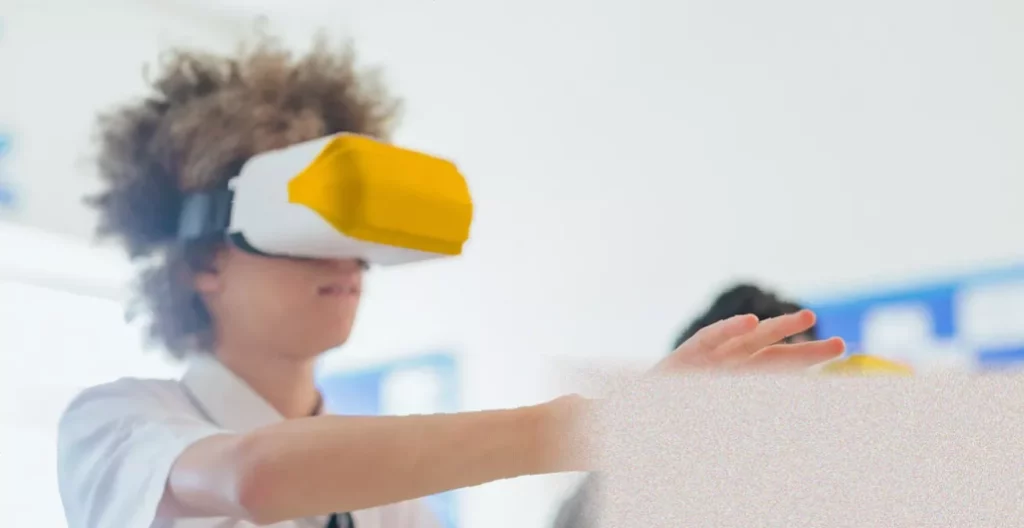
London schools are turning to virtual reality headsets to help pupils manage the mounting exam stress that has become a defining feature of secondary education, with a pilot programme showing that even a brief VR session can produce an immediate drop in anxiety.
Pilot in Sutton
All 15 secondary schools in the London borough of Sutton are now using VR headsets made by the tech firm Phase Space. The pilot is being run in partnership with the education wellbeing team of the child and adolescent mental health service (Camhs) at South West London and St George’s NHS trust – a trust that provides Camhs services across Kingston, Merton, Richmond, Sutton and Wandsworth. Ark Academy, a secondary school in north London, is also using the headsets, mainly with pupils who have social, emotional or mental health difficulties, including ADHD and anxiety.
The move comes against a backdrop of surging demand for mental health support. In England, the number of children and young people in contact with mental health services has more than doubled since 2018, placing existing Camhs services under enormous strain. Almost three in ten secondary pupils (28%) have avoided school due to anxiety in the past year, and Year 13 students are six times more likely than Year 7 pupils to do so. A survey has found that 65% of secondary school students feel overwhelmed before the school year begins, with 69% experiencing anxiety and 58% crying over schoolwork. Exams are a particular pressure point: 85% of UK students report exam anxiety, and 91% of teachers believe students worry excessively that exam results will determine their future.
How the VR programme works
The Phase Space programme runs for seven minutes and is accessed by pupils either during a prearranged slot or when they need to leave a lesson because anxiety has become overwhelming. The experience uses colours, patterns and sounds to create an immersive visual journey designed specifically for “overwhelmed and anxious students”. A co-creator of the programme, Zillah Watson, who is a former head of VR at the BBC and a visiting professor at University College London, said the technology helps young people to “ground themselves”. Phase Space has developed experiences for “Calm” and “Balance”, with content for “Sleep”, “Mindset”, “Confidence” and “Performance” in development. The programme is designed for easy adoption in schools and universities.
Research conducted with St George’s, University of London, found that a seven-minute session using Phase Space headsets led to significant reductions in stress and anxiety among healthcare students. Participants reported feeling calmer, more confident and “recharged”. The study also noted improvements in student attendance and behaviour. Among the first ten schools involved in the Sutton pilot, nine out of ten pupils who used the headsets saw an immediate drop in their stress, according to Watson.
How the programme helps pupils calm down and regain focus
Sixteen-year-old Lora Wilson described what the VR experience feels like. “You start in a room and it hasn’t got anything in it and the light in the room slowly fades and then you’re almost transported back into black but with light and it’s coming towards you,” she said. “It’s very difficult to explain but it’s a really cool experience. It almost feels like I’m somewhere else and I can just relax.”
The effect on her confidence has been significant. “Exams terrified me,” she said. “They don’t scare me as much any more. It was the most terrifying thing ever. And when I felt that way I would use the headset and it would help me process how I was feeling about it.”
Aelisha Needham, vice-principal for ethics at Ark Academy, explained how the school uses the headsets, particularly in the mornings. “We have students who in the mornings feel quite deregulated, especially when we have changes to their usual structures … such as a cover teacher, or it might be that they have felt a little bit distressed from something at home, or they maybe haven’t had breakfast, or they’re having friendship issues or haven’t done their homework,” she said.
She reported clear behavioural improvements. “Students are a lot calmer. We’re seeing a reduction in things like relocations from lessons where students are being asked to leave because they’re deregulated.” Crucially, pupils are beginning to seek the VR programme themselves. “They ask to use the programme when they start to feel overwhelmed,” she said, “which is really positive, rather than just walking out [of lessons] and walking around the school.”
Younger pupils in particular find the seven-minute session clears their mind, Needham added. “They said that they’ve improved self-control and the ability to process instructions because they feel a lot calmer and freer in terms of their mindsets and the muddling in their minds prior to that.” They use the programme to “ground themselves”, she said, and the evidence from the pilot suggests it “has led to improvements in pupil attendance, behaviour and reductions in anxiety related to exams and assessments”.
Pupil and expert reactions
Teachers have observed that students often feel their anxiety is not fully understood by educators. The VR programme, which is designed to be a low-cost and scalable intervention, may offer a way for schools to respond without relying entirely on already overstretched Camhs services. Needham noted that with Camhs services across England so overloaded, VR could prove a low-cost and effective tool for schools.
Andy Bell, chief executive of the Centre for Mental Health thinktank, welcomed the approach. “It’s encouraging to see digital solutions being used to support children’s mental health at school,” he said. “Schools have a big impact on children’s mental health and those that take a broad approach to wellbeing are better able to support inclusion, attainment, attendance and behaviour.”