

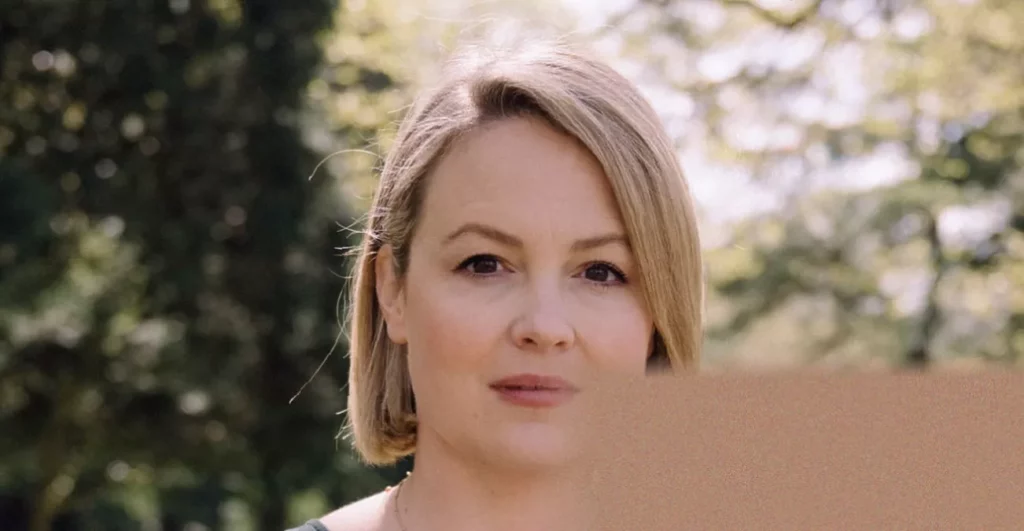
Kimberley Nixon’s memoir, She Seems Fine to Me, is published on 7 May, and the actor admits she is “quite terrified” – not of bad reviews or poor sales, but because the book lays bare the darkest, most intimate details of her experience with perinatal obsessive-compulsive disorder after the birth of her son. “In my head, I’ve written a book about what a horrible person I was,” she says. “I have to keep reminding myself that’s not it. I’ve written a book about a mental health condition and trying to fight it.”
The timing of the release coincides with Maternal Mental Health Awareness Week, an annual campaign organised by the Perinatal Mental Health Partnership UK. This year’s theme is “A Decade of Voices”, focused on ensuring women are heard about their mental health. For Nixon, the decision to publish such a raw account of her “plunge into darkness and isolation” has been fraught with anxiety. “The nature of this – the content, the detail – is so taboo,” she says. “You don’t want to share it. You keep it hidden, and that made me worse and stopped me getting better for a long time. I’m genuinely worried that people will misunderstand or read snippets and look at me differently.” Yet she also hopes the book might be the biggest step yet in her recovery: “If I can say it out loud and let it wash over me, it’ll be the biggest step in my recovery yet.”
Nixon, 40, is best known to audiences as the Welsh actor who played “Slaggy Lindsay” in Angus, Thongs and Perfect Snogging and Josie in Fresh Meat, with further credits including Cranford, Wild Child and Hebburn. More recently she appeared in the crime drama Under Salt Marsh as a bereaved mother. But to thousands of new mothers, she is known through her Instagram and Substack, where she has been sharing the unvarnished reality of early motherhood. Her son is now five and a half and, she says, “the happiest, most well-adjusted kid”. But his arrival plunged her into a nightmare of obsessive fears and suicidal despair.
‘Like somebody flipped a switch in my brain’
Nixon and her husband – whom she does not name in the book, describing him only as someone who “didn’t choose to be in the public eye” – had been trying for a baby for four years before turning to IVF. Her memoir details every step of the process: the hormonal highs and lows, the egg collection and transfer, the constant monitoring. One time, newly pregnant, Nixon was in London for a voiceover when her clinic called to say her latest blood tests indicated she was about to miscarry. (She did not.) For each subsequent scan, she was alone because of pandemic lockdown rules. As her due date approached, she wrote to her MP about the rules governing labour, which meant her husband could not join her until she was 5cm dilated and would have to leave an hour after the birth – at a time when the rest of the UK was being urged to “eat out to help out”. “If I’d given birth in this cafe, I could have had five friends with me,” she says. “Whereas in hospital I’d have to be on my own.”
After the birth, her son was transferred to the special care baby unit with possible sepsis. Nixon could not accompany him because she was receiving a blood transfusion. Her husband faced an impossible choice under Covid rules: stay with her or go with their son – whichever he chose would be the only one he could see from then on. Nixon pushed him towards the door, and that first stretch alone on the ward may have been the trigger for her spiralling. She became convinced her son had died and no one was telling her. In truth, he was fine and returned to her hours later. But for the remainder of her hospital stay – sleepless, hypervigilant, in a hot, empty, brightly lit ward sealed off from the world – the seeds of her OCD were sown.
Back home, another lockdown was announced and the clocks went forward. “Maybe it wasn’t all in my head,” she writes, “that I was plummeting into both a darkness and an isolation, the likes of which I’d never known.” Almost immediately, she began second- and third-guessing every decision involving her son. She saw danger everywhere: her son dying from hypothermia, a dog attack, a fatal fall, being kidnapped and abused. Her thoughts were often sexual or violent – had a paedophile ordered her son on the dark web? Had his milk powder been spiked with anthrax? She doubted her own capacity to keep him safe and feared she was a danger to him. “It’s all the time, every minute of every day, variations on a theme,” she says. “You can’t live like that. After four months, I started thinking: ‘Oh my God, maybe there is a way out.’” Her thoughts became suicidal.
How intrusive thoughts become obsessional
OCD is believed to affect about 3% of the population, and frequently worsens or appears during pregnancy or after birth. Intrusive thoughts are far more common – research suggests that more than 95% of new parents experience them. But in OCD, they spiral into obsessional, all-consuming loops. “What I didn’t know then was that the thoughts themselves don’t matter – it’s how we react to them,” Nixon explains. “The more you try to stop them, the harder they come. Your brain is sending false emergency flares all the time, as you’re trying to analyse each thought and what it says about you. It’s like my body was saying: ‘Oh my God, this thought is really important, we need to pay attention to this and solve it or someone’s going to die, there’s a gun to our head!’”
The key, she learned, is exposure and response prevention (ERP) therapy – a highly specialised form of cognitive behavioural therapy considered the gold standard treatment for OCD. ERP works by retraining the brain to let intrusive thoughts pass without judgment or compulsive responses. “Don’t judge them, don’t beat yourself up, and they drop off,” Nixon says. “Your body starts saying: ‘Yeah, we’ve seen this, don’t worry about it.’” But accessing that treatment was far from straightforward. Nixon had to find and pay for it herself, at £100 a session – spending her entire “actor’s nest egg” on therapy. (Private ERP sessions in London can range from £108 to £120 per 50-minute session, with some specialist OCD assessment packages costing around £330.) The lack of support from perinatal mental health services is a source of deep anger for her. “Everything was done by phone and no one really saw you,” she says. “It’s really hard to talk about the darkest time of your life over the phone to a stranger and even harder doing it for the 20th time, when you never speak to the same person again.”
NHS England has been working to expand specialist perinatal mental health community care, aiming for 66,000 women to access support by 2023/24. These services are designed for women with moderate to severe difficulties during pregnancy and up to a year after birth, with referrals through GPs, midwives or health visitors. But Nixon’s experience highlights what she sees as a significant gap in consistent, in-person support.
Recovery through connection and understanding
What helped Nixon through, beyond the ERP, was her husband’s unwavering support. The couple have been together for 21 years; he attended the same school and now lives with her and their son in Pontypridd. Years earlier, as a drama student, Nixon had experienced a similar episode: while watching a long Shakespeare production, her mind wandered to a gross sexual image of a family member. “I couldn’t let it go,” she says. “I couldn’t stop thinking about the fact that I’d thought it.” She was misdiagnosed with generalised anxiety disorder and given just three therapy sessions. “So all these years later, when I said to my husband: ‘I think it’s happening again,’ he just got it in a way that I think saved my life.” He never faltered in his belief in her. “I’d ask him: ‘How can you leave me with the baby? What if I’m a danger to him?’ and he’d say: ‘Because I have absolutely no worries whatsoever. You’d give your life in a second for the baby.’ I clung on to that.”
Perhaps the most surprising breakthrough came through social media. Nixon was not on Instagram before having a baby (she joined only because someone told her about an account offering free dungarees). When she started posting, she says, “I didn’t have the bandwidth to put a front on, I didn’t have the energy to lie.” The response was overwhelming. “I was getting hundreds and hundreds of messages. There’d be women who were 18 months postpartum going to see their GP because of a post. There were women in their 50s and 60s saying they’d never forgiven themselves for how ill they were in the first couple of years of motherhood – and they’d never told their husband. I had loads of messages from partners saying: ‘This is my wife. How can I help her?’” Opening up, she says, was “the biggest fuck you to OCD I’d ever done”. Writing a book is the next level up.
Last June, Nixon was clinically diagnosed with autism and ADHD. “There’s a huge crossover between OCD and autism,” she says. “It helped me understand the way I think, the way I process things.” The diagnosis has brought a sense of relief. Recovery has not been linear – it was 18 months before she stopped wishing she was dead, maybe two years before she began to trust and forgive herself. She still has “a little stumble now and again”. Medication, journalling and breathing exercises all help. She is also touring a one-woman comedy show, Baby Brain, described as a “slightly true story” about motherhood, postpartum psychosis and stand-up comedy, set in a mother-and-baby unit.
When women in the midst of it ask how long before she felt like she used to, Nixon’s answer is blunt: she doesn’t and never will. “I can’t ever go back to being the person I was. Wanting to go back stopped me getting better for a very long time.” But she can be stronger, happier even. “All my life, I was looking to see if I was in trouble somehow. I used to care too much about everything, about what people thought of me. I’ve learned not to do that now. If all this hadn’t happened, my son wouldn’t be here, I wouldn’t have written a book, I wouldn’t have found out so much about how my brain works. I’m so much happier for it.”