

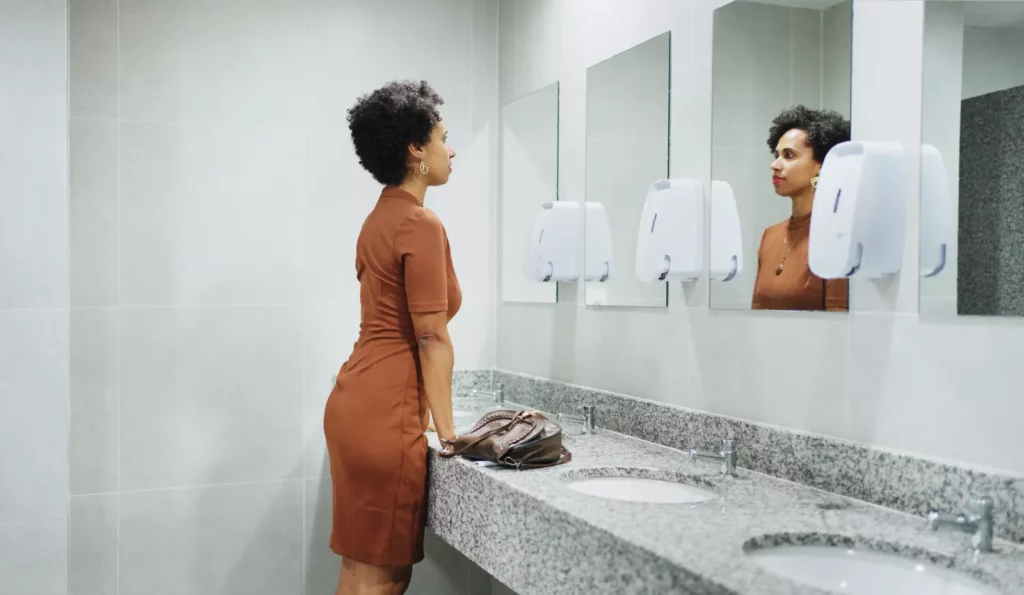
Half of Brits admit to using office toilets as a private escape, according to a study that lays bare the scale of a habit human resources professionals say has been common since the invention of the lavatory itself. The phenomenon, described by some as “loo lurking”, sees employees retreat to cubicles not only for emotional release but for quiet time, social media scrolling, and simple avoidance of colleagues.
The prevalence of loo lurking
One in five UK office workers said they use the toilet as a safe space to “cry their eyes out,” with the youngest employees most likely to do so. A survey found that 21% of workers aged 18 to 24 admit to this behaviour, citing work stress as the main reason, while 14% of those aged 25 to 34 do the same. Beyond tears, 41% of workers retreat to a cubicle for quiet time, with those aged 35 to 44 the most likely to do so, according to Initial Washroom Hygiene’s study of 2,000 employees.
The same research reveals what else goes on behind locked doors: a quarter of staff scroll through social media, 19% check the news, and 11% touch up their makeup. On average, office workers spend nearly 14 minutes a day in the toilet, equating to approximately 56 hours a year, or seven working days. One in three admit they use the toilet even when they do not need to, simply to escape colleagues and take a break from work. A separate study by Topps Tiles found that over half of women (52%) use the toilet as a place to escape high levels of anxiety.
Why employees seek solitude in the smallest room
The reasons behind this widespread behaviour run far deeper than a simple need for privacy. Work-related stress and pressure are the primary drivers. Mental Health UK reports that 91% of employees experienced high or extreme levels of pressure or stress in the past year. Among 18- to 24-year-olds, 39% have taken time off work due to poor mental health caused by pressure and stress. Meanwhile, burnout — defined by the World Health Organisation as a state of physical, mental, and emotional exhaustion due to long-term stress — is increasingly prevalent. Some 65% of UK workers experienced burnout in the summer of 2024, affecting over 16 million full-time employees. A broader picture shows that 79% of employees experience moderate-to-high stress levels, and 63% of UK employees show symptoms of burnout, up from 51% two years ago.
Jim Moore, an employee relations expert at HR consultants Hamilton Nash, said the toilet remains the “one place in an office where you can get some privacy,” and that most HR professionals can recall colleagues who disappear there for longer than necessary. He noted that while the habit is nothing new, it is now being discussed more openly because of more honest conversations about workplace mental health. “People feel less ashamed to acknowledge they need these moments of escape,” he said.

Yet the choice to hide in a cubicle rather than seek formal support is telling. Moore explained: “Going to HR with workplace problems means you need to spell out exactly what’s wrong, with the risk you’ll trigger formal processes. Seeking formal support can sometimes feel like a much bigger step than just taking a few minutes alone. Sometimes people just need five minutes to compose themselves, have a quick cry or escape an overwhelming situation, and the toilet provides that without consequences or awkward conversations.”
The need for “me time” during the working day is another factor. Beyond emotional distress, many employees simply crave a break from the office environment. A significant number of workers — one in three — use the toilet even when they do not need to, purely to get away from colleagues. The pressure to appear constantly productive, combined with a lack of private space, drives people to the one room where they can be alone without explanation.
Workplace culture itself plays a major role. When a large proportion of staff resort to toilets for mental health breaks, Moore argued it represents a “damning verdict on workplace culture.” He added: “Managers who create environments where people feel they can’t admit they’re struggling or take a visible break are directly contributing to this behaviour.” Overwhelming workloads, workplace conflict or bullying are often the underlying causes when employees are crying in toilets for reasons unrelated to their personal lives.
Younger employees are particularly affected. Those aged 16 to 24 show the highest stress levels and are more likely to report unmanageable workloads, financial strain, isolation, and bullying. Across the workforce, nearly two-fifths of UK workers (39%) reported feeling burnt out in 2025. One-third of UK employees — approximately 10 million people — faced mental health challenges in 2025, and it is estimated that 15% of UK workers have an existing mental health condition. The cost to employers is staggering: poor mental wellbeing costs UK employers an estimated £42 billion to £45 billion annually, and in 2023/24 an estimated 776,000 workers suffered from work-related stress, depression, or anxiety, leading to 16.4 million working days lost.
What employers should do
Jim Moore said that if employees are frequently hiding in toilets, bosses need to be aware that it signals a problem with either individual wellbeing or the workplace environment itself. He urged managers to create environments where people feel comfortable stepping away from their desk, taking a proper break, or being honest about having a difficult day.

Employers have a legal duty of care under the Health and Safety at Work Act 1974 and the Equality Act 2010 to safeguard employee mental health. Beyond legal obligations, experts recommend fostering a “psychologically safe” culture where open conversations about mental health are normalised. This includes training managers to identify early signs of distress and provide appropriate support. Employee Assistance Programmes (EAPs) offer confidential services for personal and professional challenges, while broader mental health support programmes can include counselling, online therapy, mental health days, and digital tools.
Some companies have introduced “tea leave” initiatives — short, no-questions-asked breaks of up to 30 minutes for employees to step away from their desks, recognising the positive impact of breaks on wellbeing and connection. A positive workplace culture should aim to reduce “ill-being” by minimising negative aspects such as bullying, favouritism, burnout, and lack of career progression. Employees also value autonomy and flexibility, with control over how, when, and where they complete their work — factors that can enhance wellbeing and work-life balance.
For individuals, resources from Mental Health UK advise creating a personal wellbeing plan, setting boundaries and achievable goals, communicating openly with a manager, prioritising sleep, exercise, nutrition, and stress management, and making full use of workplace support including EAPs. The government’s Access to Work scheme also provides grants for practical support and mental health management for employees with disabilities or health conditions.
Yet the fundamental issue remains that a fifth of workers are crying in toilets and 41% are using them for mental health breaks. As Moore put it: “People should feel comfortable stepping away from their desk, taking a proper break or being honest with their manager that they’re having a difficult day.” The cubicle, he suggested, should not be the only place in the office where that is possible.