

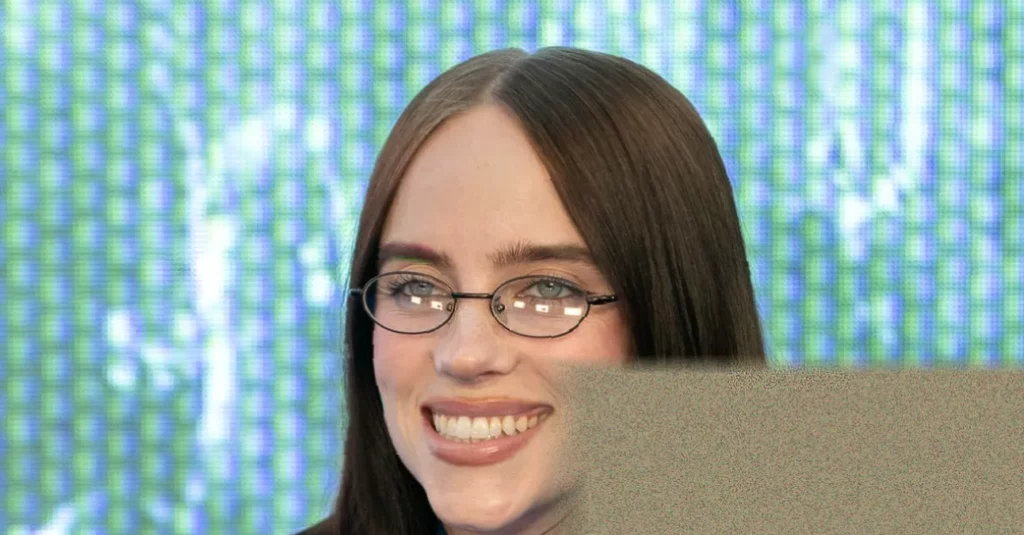
Billie Eilish has described the constant, exhausting effort she puts into suppressing her Tourette syndrome tics, particularly during interviews, where she says she is “doing everything in my power” to hide the involuntary movements and sounds from view. The 24-year-old singer, who was diagnosed with Tourette’s at the age of 11, told Amy Poehler on the actor’s Good Hang podcast that the moment she leaves a room she must “let them all out”, releasing the tics she has been forcing down throughout a conversation.
Suppression, Eilish explained, is not a simple matter of stopping tics from happening. It is a conscious, physically demanding act that she maintains for as long as she is on camera or in public. “I’m really doing this the whole time – as much fun as I’m having – I’m doing everything I can to suppress every single tic that’s visible, from the top of my head to [my waist],” she said. Even when she appears still, her body remains in a state of tension. “If you didn’t see me tic today, you’re not looking at my knees, which are tic-ing constantly under this table, and my elbows that are like … I’m clenching my arms the entire time,” she added.
According to the NHS, Tourette syndrome causes involuntary, sudden, repetitive sounds or movements known as tics, which can be triggered by stress, excitement or tiredness. The condition is neurological, not behavioural, meaning individuals cannot simply choose to stop. However, many people with Tourette’s can suppress their tics for short periods, though this requires significant concentration and effort and can be deeply tiring. The release of suppressed tics when suppression stops can be intense. Eilish’s description of “let them all out” reflects this common experience. Many people with Tourette’s also experience a premonitory sensation or urge before a tic, which is only relieved once the tic occurs.
Tics vary widely. Simple motor tics include blinking, facial grimacing, head jerking, and tensing of muscles. Eilish has previously mentioned specific tics such as wiggling her ears, raising her eyebrows, clicking her jaw, and flexing her arms. Complex motor tics involve bending, twisting, jumping, or making gestures. Vocal tics can be simple – throat clearing, grunting, sniffing – or complex, such as repeating whole phrases. Eilish noted on the podcast that her vocal tics are “mostly just noises and I can keep them pretty quiet”, though she added that she goes through phases where words become tics. Contrary to a common misconception, the involuntary swearing or uttering of obscene words – known as coprolalia – affects only about 10 to 20 percent of individuals with Tourette’s.
Tics typically begin in childhood, between ages five and ten, and often peak around ten to thirteen. Eilish was diagnosed at eleven. Triggers can include stress, anxiety, excitement, tiredness, and sensory overload. During a 2022 interview with David Letterman on his Netflix show My Next Guest Needs No Introduction, Eilish spoke about how lighting can provoke her tics and described the exhaustion they cause. She also expressed frustration at people who laugh at her tics, mistaking them for attempted humour.
That frustration was central to her conversation with Poehler. Eilish compared living with Tourette’s to experiencing intrusive thoughts – but with the added layer that “your mouth has to say them out loud”. She said the biggest difficulty is the widespread lack of understanding. When she has a “tic attack” – a rapid series of tics – people often ask, “‘Are you OK?’,” even though the episode is normal for her. “That’s how we, as people with Tourette’s, pretty much spend our days,” she said. “Some people don’t even have the privilege of getting to suppress them at all in any way. The not understanding of that is really frustrating, as a person with Tourette’s.”
Eilish rose to fame at age 14 with her song Ocean Eyes, and has since achieved two UK number one singles and three chart-topping albums. Her debut album When We All Fall Asleep, Where Do We Go? (2019) topped charts on both sides of the Atlantic, and the single Bad Guy became her first US number one. Subsequent albums Happier Than Ever (2021) and Hit Me Hard and Soft (2024) continued her commercial and critical success. She has won ten Grammy Awards, two Academy Awards, and three Brit Awards, becoming the youngest person to win Grammy Album of the Year and Record of the Year, and the first person born in the 21st century to win both a Grammy and an Oscar. Other celebrities who have spoken publicly about living with Tourette syndrome include Lewis Capaldi, Dan Aykroyd, Howie Mandel, David Beckham, and former footballer Tim Howard.