

A psychologist launched a national protest movement from her pyjamas. Colette Delawalla, a 30-year-old clinical psychology PhD candidate at Emory University and mother of a toddler, had reached her limit nineteen days into Donald Trump’s second term. Still in her pyjamas around noon, she sat on the floor of her Atlanta apartment and posted on Bluesky: “Can’t believe I’m typing this but… FUCK IT IM PLANNING A STAND UP FOR SCIENCE PROTEST IN DC.” Her palms were sweating. Her political experience consisted of voting and attending a single Black Lives Matter demonstration. “I sure as hell didn’t consider myself an ‘activist’,” she later said.
The trigger had been swift and severe. The Trump administration had just announced $4bn in cuts to medical and scientific research. Government scientists had been ordered not to speak at conferences or in public. The National Institutes of Health (NIH) was purging grants that conflicted with presidential orders on “gender ideology” and “diversity”. The scientific community, Delawalla felt, had put up little fight – and that made her livid.
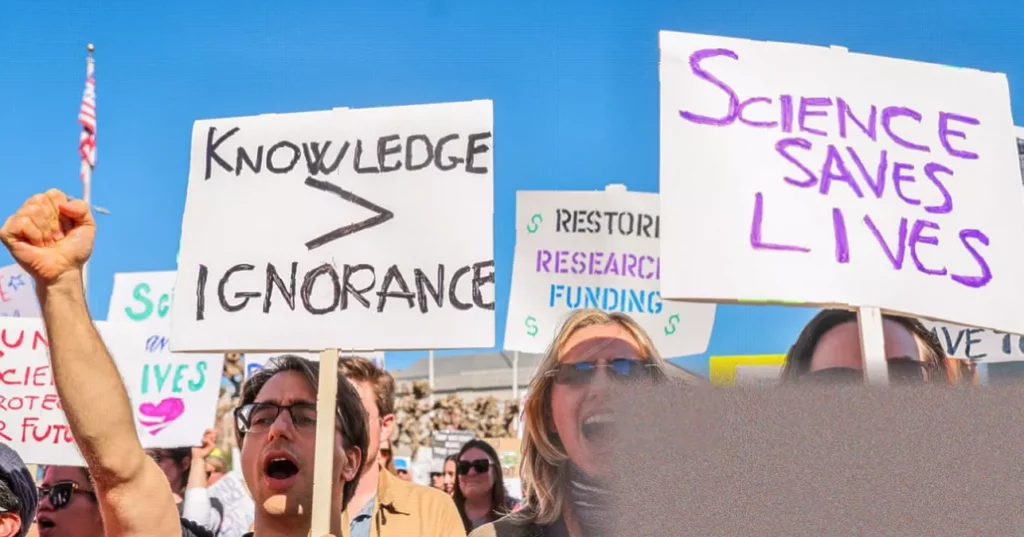
Her post went viral. Within 72 hours, she was on the phone with The New York Times. In less than a month, a team of volunteers led by Delawalla and four other early-career scientists – JP Flores, Emma Courtney, Sam Goldstein and Leslie Bernsten – organised protests on 7 March 2025 in more than 30 US cities. They did it without the support of a single major scientific organisation. The movement, which registered as a 501(c)(4) non-profit with a separate 501(c)(3) charitable foundation, called itself Stand Up for Science.
From a Single Day of Protest to a Sustained Political Force
But staging the demonstrations turned out to be the easy part. Transforming a single day of protest into a sustained movement proved far harder. “The challenge comes after an initial wave of activity that doesn’t lead to the change you had hoped for and you don’t get a shift in policy – how does an organisation make sense of loss?” said Hahrie Han, a political science professor at Johns Hopkins University and author of Prisms of the People: Power & Organizing in Twenty-First-Century America. After the crowds went home and the scientists returned to the lab, the funding cuts remained. So did the purge on studies of gender, DEI and other prohibited subjects. Delawalla had to figure out where to go from there.
“It got very quiet,” said Brynn Paulsen, then a volunteer at Stand Up for Science and a doctoral candidate in clinical psychology. Part of it was burnout among volunteers who had worked furiously to stage the protests, Paulsen said, “part may have been that we were all flying by the seat of our pants”, with little organisational structure.
That would change. Over the next year, Stand Up for Science would lose three key organisers but build to its current peak of 22 paid staff, including Delawalla, and more than 2,000 registered volunteers. The organisation raised $1.2m in donations and won support from more than 65 Nobel laureates, a sign that its message was resonating in scientific research circles. The Union of Concerned Scientists Science Network reported a significant surge in membership in response to the administration’s agenda, and groups such as 314 Action began actively supporting scientists running for office.
The administration’s approach to science had grown only more aggressive. The Trump administration proposed a fiscal year 2026 budget that would cut the NIH by roughly 40% and slash NASA’s science directorate by more than half. The NIH capped indirect costs on grants at 15%, a move that sparked lawsuits and threatened to cripple university research infrastructure. Critics saw these policies as aligning with Project 2025, an initiative that outlined plans to combat what it characterised as subsidies for “leftist agendas” and DEI efforts. The slogans at Stand Up for Science rallies – “Science not silence” – reflected a movement that described the administration as “the most aggressively anti-science government the United States has ever had”.
Yet Delawalla’s fiercest critics were not Maga supporters, but fellow scientists and leftwingers. Some scientists took issue with her language, her references to “fascism” and “authoritarianism”. Beneath certain comments ran an undercurrent of the sexism prevalent in science. “To have any chance of reaching those who might be interested in stopping this political madness, you should consider a voice that sounds less like a (and I honestly don’t mean to insult you) ditsy socialist liberal and more like a concerned adult,” a male scientist wrote below one of Delawalla’s YouTube interviews. (She promptly added “ditsy socialist liberal” to her Bluesky bio.)
The challenges echoed those faced by previous science activism. The March for Science in 2017 had drawn more than 1 million people worldwide but saw attendance plummet at follow-up events. Rush D. Holt, the former CEO of the American Association for the Advancement of Science, which sponsored the March for Science, said momentum may have stalled during Trump’s first term because funding did not crater as scientists had feared, or because researchers failed to convince the public that science matters to their own lives. Political activism, many noted, is ill-suited to the scientific mindset – the training that demands researchers resist a theory until they have done everything to disprove it. “It’s hard for scientists to be black and white, to not provide caveats to every single statement,” Delawalla said.
Soon after the initial protests, three of the five lead organisers of Stand Up for Science broke away. Emma Courtney said she and others felt they had been given an insufficient role in decisions and believed that focusing on protests would only energise the base rather than convert sceptics. “We’re hoping to engage people that might not know or care about science, or might be sceptical about it,” said Courtney, who left with two others to form the nonprofit Science for Good. Delawalla preferred to focus on “direct action”, a need she felt was not being met by other pro-science groups. After the protests, several staffers told Delawalla she needed to make a choice: either quit pursuing her doctorate or hand over leadership. She found the choice an annoying echo of warnings she had received against becoming a mother while still working on her dissertation. Why could she not do both?
A Rapid Political Education
Raised in rural Ohio, Delawalla had dropped out of community college in Indiana after studying and hating accounting. She returned to school four years later and eventually earned dual master’s degrees in clinical psychology and quantitative psychology from Ball State University. She was drawn to the study of addiction, a condition that had affected her family. Inexperienced though she was in politics, Delawalla recovered from the split with the Science for Good organisers and drew together a team that included young scientists like herself as well as a few seasoned campaigners. Stephen King, a political organiser and mass fundraiser for numerous environmental and social justice causes who became Stand Up for Science’s chief operating officer, said Delawalla “is a very quick study” and takes advice well. King, 68, also recruited Vincent Vertuccio, a 22-year-old consultant with a chest tattoo reading “Organizing Works”, who had experience with campaign machinery: phone banks, door-to-door canvassing, advertising and social media.
Four months after an unprepared Delawalla had struggled through her first meeting on Capitol Hill – a sit-down with Democratic Illinois congressman Bill Foster to deliver a message she described as, “Hey, this stuff with Trump and science is very bad!” – she took a different approach. This time, she spent eight hours prepping with Vertuccio for a meeting with Mike Levin, a Democratic congressman from California. Her comfort level grew, and over the next year, she delivered a more focused Stand Up for Science message in 200 congressional meetings.
In the autumn, the organisation led other health-related groups in launching a campaign to impeach Robert F. Kennedy Jr., the secretary of Health and Human Services, delivering a petition to Congress with 150,000 signatures. Andrew Nixon, a spokesperson for the Department of Health and Human Services, said the secretary “remains focused on fixing a broken status quo and delivering results for the American people, not responding” to impeachment efforts “designed to prop up a failing campaign”.
Before the year was out, Stand Up for Science made its first foray into electoral politics, running a late-stage effort to swing a Tennessee congressional race to Democrat Aftyn Behn. The group made 65,000 phone calls and knocked on hundreds of doors in rural areas of the district. Behn lost by 8.9% – in a district Trump had captured by more than 20% the previous year. The race, against Republican Matt Van Epps, demonstrated the movement’s ability to move the needle even in deep-red territory.
This March, Stand Up for Science held demonstrations in more than 50 US cities to mark its anniversary. At the National Mall, the crowd topped out at about 2,000 people – half the size of the previous year. “We had people come out in every state for science,” Delawalla said, stressing that the events came off without incident and received press coverage despite occurring a week after the US and Israel launched military operations in Iran. On Friday, Delawalla and her colleagues plan to establish the Science Victory Fund, a Super Pac that will back pro-science candidates in the 2026 midterm elections.
Delawalla still intends to complete her dissertation this summer, but she has chosen to go “all-in” on the work of defending research, a decision that means giving up her own research career. “It was a decision that came with a lot of grief,” she said. “Being a scientist is a huge part of my identity; research is where I found my purpose and place in the world.” Ultimately, she felt her own research was not as important as protecting the work of other scientists engaged in projects that may yield new cancer treatments or ways to address the climate crisis. “I happened to stumble upon a skill set within myself that I can use to keep those people discovering,” she said. “It’s where I belong in this moment.”