

The US Supreme Court on Monday confronted the thorny intersection of federal pesticide regulation and state consumer protection laws, as justices peppered lawyers in a landmark case that will decide whether companies like Bayer can be sued for failing to warn about cancer risks when the Environmental Protection Agency has not required such a warning. The central legal question in Monsanto v. Durnell is whether the Federal Insecticide, Fungicide, and Rodenticide Act — known as FIFRA — preempts state-level failure-to-warn claims, effectively shielding manufacturers from lawsuits that allege their products cause harm.
Core legal question: the reach of federal preemption
The case centres on glyphosate, the active ingredient in the popular weedkiller Roundup, which is manufactured by Bayer’s former Monsanto subsidiary. The World Health Organization’s International Agency for Research on Cancer classified glyphosate as a “probable human carcinogen” in 2015, a finding that has underpinned more than 100,000 lawsuits from people who developed non-Hodgkin lymphoma they attribute to exposure. Bayer has already paid billions of dollars in jury awards and settlements, but it now argues that federal law should block these claims. In the Durnell case, a Missouri jury awarded the plaintiff $1.25 million in compensatory damages after finding that Monsanto failed to warn him of glyphosate’s cancer risk. The Missouri Court of Appeals upheld the verdict, and Bayer appealed.
The crux of the argument is FIFRA’s preemption provision. Monsanto contends that because the EPA has approved Roundup’s label — which does not carry a cancer warning — the company cannot be held liable under state law for failing to add a warning that the federal regulator has not mandated. Paul Clement, Monsanto’s attorney, told the justices that FIFRA is “crystal clear” in barring pesticide makers from altering a label without EPA approval. “Congress plainly wanted uniformity when it came to the safety warnings on a pesticide’s label,” Clement said. “Ignoring Congress’ clear direction here would open the door for crippling liability and undermine the interests of farmers who depend on federally registered pesticides for their livelihood.” He argued that the EPA’s process is rigorous, and that the agency’s position — that glyphosate is “unlikely” to be carcinogenic — is supported by other regulatory agencies “around the globe”.
The Trump administration, through Principal Deputy Solicitor General Sarah Harris, backed Monsanto, telling the justices that states cannot “second guess or undermine” the EPA’s regulatory process. The Department of Justice’s position aligns with an executive order issued by President Trump that declared increasing domestic production of glyphosate a national security issue.
On the other side, Ashley Keller, representing the plaintiff John L. Durnell, argued that FIFRA does not provide the blanket preemption Monsanto claims. He told the court that “the United States is wrong” and that FIFRA’s preemption clause only bars state requirements that are “in addition to or different from” federal ones. Failure-to-warn claims, he said, enforce FIFRA’s existing misbranding prohibition rather than adding new requirements. Keller also highlighted what he described as significant flaws in the EPA’s registration process, noting that the agency had not updated its glyphosate registration review every 15 years as the law requires. “Things slip through the cracks with that agency,” he said. He pointed to a 2022 ruling by the Ninth Circuit Court of Appeals that vacated the EPA’s human health findings on glyphosate, concluding that the agency had failed to follow established guidelines for determining cancer risk and had ignored important studies.
The Supreme Court itself had previously declined to hear appeals in similar FIFRA preemption cases — Hardeman and Pilliod — but the Durnell case presents a direct conflict between circuit courts. In August 2024, the Third Circuit ruled that FIFRA does preempt state failure-to-warn claims, diverging from the Ninth and Eleventh Circuits, which have held that such claims are not preempted. That circuit split increased the likelihood that the high court would take up the issue.
Arguments on both sides: uniformity vs. accountability
During Monday’s oral arguments, justices on both sides of the ideological divide pressed the lawyers on the practical implications of their positions. Some liberal justices appeared skeptical of Monsanto’s argument, asking how labeling should be handled when new scientific evidence emerges between EPA reviews. Other justices probed the fairness of penalising a company retroactively for a lack of warning on a label that the EPA had approved. “Both sides put on a good case,” said Daniel Hinkle, senior counsel for policy at the American Association for Justice, who attended the hearing. “I thought they asked some serious questions and were really grappling with the implications of the case.”
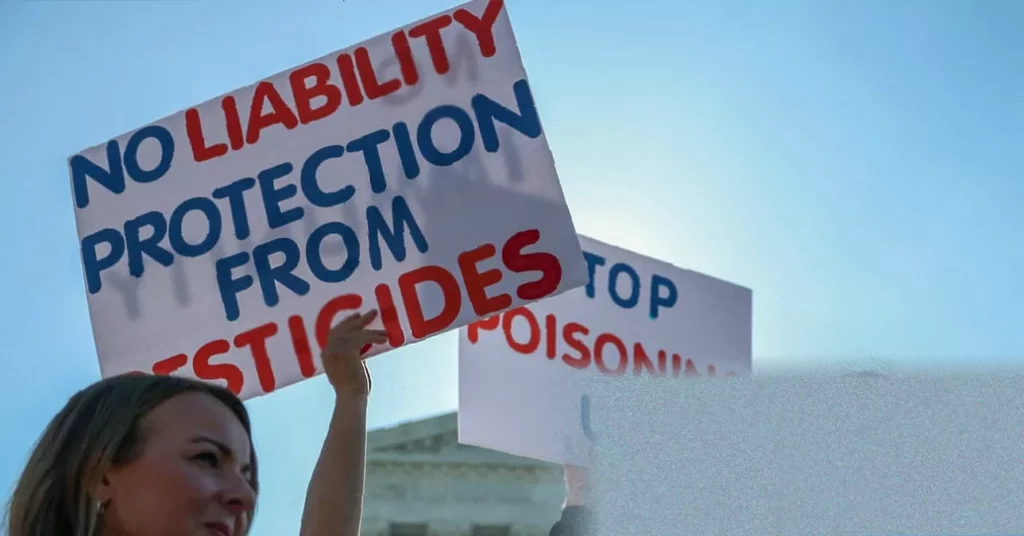
Outside the court, protesters from the Maha movement — Make America Healthy Again — rallied, chanting “people over poison” and waving signs that read “Roundup the guilty” and “Make Monsanto pay”. Zen Honeycutt, founder of Moms Across America and a Maha leader, said: “It’s crucial right now to show up and let not just the supreme court know but also our legislative branch and our executive branch that we will not stand for being poisoned … any more. These companies must have accountability and it starts today.” Independent toxicologist Alexandra Munoz, who was marching, said: “I’ve read the literature on glyphosate and it is definitely a carcinogen. The evidence is really clear.” Democratic Representative Chellie Pingree of Maine joined the rally, noting that she had been fighting these issues for a long time. “To have an actual rally in front of the supreme court, to have so many people show up from all over the country and to have so many Republicans and Democrats who are united about keeping poisons out of our food, out of our environment, out of our agriculture system, it’s a big day,” she said.
Potential implications: what a ruling could mean
A ruling in favour of Monsanto would make it substantially harder for consumers to file failure-to-warn lawsuits not only against the company but against any pesticide manufacturer. Bayer has stated that a favourable decision would help put an end to the vast majority of Roundup litigation. In a statement issued after the hearing, Bayer said: “We believe the US government and the company made persuasive arguments that state-based warning claims ‘in addition to or different from’ warning labels approved by EPA under FIFRA, as in Durnell, are preempted, and this is necessary to avoid a patchwork of 50 different warning labels. Companies should not be punished under state law for complying with federal label requirements. The security and affordability of the nation’s food supply depend on farmers’ and manufacturers’ ability to rely on the science-based judgments of federal regulators.”
Major agricultural groups, including the American Farm Bureau Federation and the American Soybean Association, have filed briefs supporting Bayer, arguing that glyphosate is critical for farming and that ending its use would threaten the food supply. Bayer’s own CEO, Bill Anderson, has said: “It is time for the U.S. legal system to establish that companies should not be punished under state laws for complying with federal warning label requirements.”
Conversely, a ruling against Monsanto would preserve the ability of state courts to hear failure-to-warn claims, allowing thousands of plaintiffs to continue seeking compensation. Environmental, farmworker and public health organisations have filed briefs supporting Durnell. The broader implications extend beyond pesticides: the decision could reshape the doctrine of federal preemption in toxic tort cases, affecting how states regulate hazardous products and how consumers hold companies accountable.
Monsanto’s legal argument has often hinged on the phrase “the label is the law” — meaning that compliance with the EPA-approved label is the sole requirement. Durnell’s side counters that this phrase refers to user compliance, not to the label’s preemptive force against state tort law. The Supreme Court’s 2005 decision in Bates v. Dow Agrosciences clarified FIFRA’s preemption scope but left room for interpretation, and the current case will test the boundaries of that ruling.
Coinciding with the Supreme Court hearing, the US House of Representatives Rules Committee is considering the new Farm Bill, formally known as HR 7567, the Farm, Food and National Security Act of 2026. Representative Pingree and Representative Thomas Massie, a Republican from Kentucky, last week announced an amendment that would remove provisions intended to shield chemical manufacturers from lawsuits and to preempt state and local warning label laws. Pingree described those provisions as a “gift to Big Chemical” that would handcuff states if federal regulators are slow or influenced by industry pressure.
Bayer has also sought to settle most remaining and future Roundup lawsuits. In February 2026, the company announced a proposed $7.25 billion settlement, which is subject to court approval and may not affect claims related to pending appeals. As of early 2026, approximately 61,000 to 65,000 lawsuits were still pending.
A ruling from the Supreme Court is expected by the end of June 2026.