

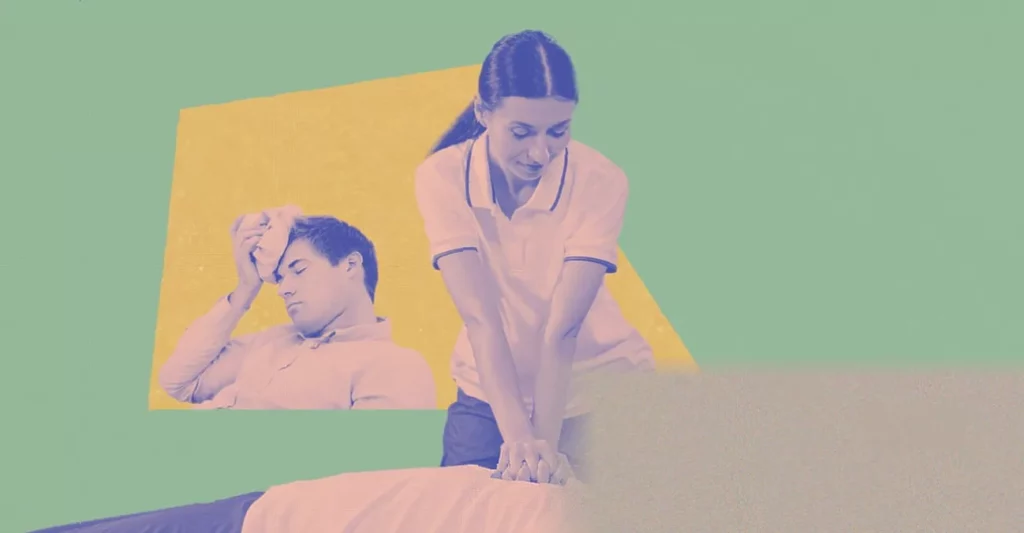
Every minute delay in restarting a heart reduces survivability by 10%, according to Richard Webber, an associate clinical director of St John Ambulance and a practising NHS paramedic in the south of England. “If you learn one thing, it should be how to resuscitate,” he says. In the UK, around 40,000 out-of-hospital cardiac arrests occur each year, yet the current survival rate is just 9%, notes Emily Le-Gallienne, a resuscitation officer and paramedic for the East of England ambulance service. She points to countries like Denmark and Sweden, where survival rates are far higher because more people are taught cardiopulmonary resuscitation (CPR). “CPR and defibrillation can increase the chance of survival by up to 70% if it is done in the first three to five minutes of cardiac arrest, and an ambulance may not arrive in that time,” she explains. A CPR element has recently been added to the UK driving theory test, which Le-Gallienne describes as “really positive progress”.
Cardiopulmonary resuscitation (CPR)
Before starting CPR, you must call for an ambulance. It is essential to be certain that the person is not breathing, because they could be unconscious but not in cardiac arrest, says Oliver Siddell, a paramedic from Leeds who works for the Yorkshire ambulance service. To check, “open their airway, by tilting the head back and lifting the chin”, says Le-Gallienne. “Look at the person’s chest to see if you can see if it is rising and falling, and get really close to the person to see if you can feel any breath on your cheek. Check for a pulse if you are confident to do so. If they aren’t breathing or if their breathing is abnormal – slower, irregular or gasping – then that could be a cardiac arrest.”
Once cardiac arrest is confirmed, begin chest compressions. “Use the heel of the hand,” Le-Gallienne advises. “Put the hands on top of each other, interlocking if it is comfortable, then push into the centre of the chest. You need to make sure that you’re doing it deep enough: for adults it is between 5cm and 6cm; for children, at least one-third of the depth of their chest, not exceeding 6cm.” The correct pace is 100–120 compressions per minute. All the paramedics recommend thinking of a song to keep rhythm, such as Stayin’ Alive by the Bee Gees or Pink Pony Club by Chappell Roan. Le-Gallienne notes that the British Heart Foundation has a CPR playlist on Spotify. Ideally, you should perform 30 chest compressions followed by two rescue breaths into the person’s mouth. However, Webber says that “some people feel uncomfortable doing ventilations, particularly if they don’t know the person”. In that case, focus on compressions alone: “That buys time, keeps oxygen going to the organs, and keeps the heart and brain alive.”
If you are able to deliver rescue breaths, Araf Saddiq, a paramedic with the Scottish ambulance service stationed in Douglas, South Lanarkshire, explains: “Pinch the nose and open the mouth with your other hand and slowly breathe into the mouth. Wait until their chest comes back down and then breathe in once more. After the second, continue with the chest compressions.”
Defibrillation
Using a defibrillator as soon as possible is critical. You can find out online where your nearest community defibrillator is located, says Webber – at a library, community centre, or even in a former phone box. Never leave the injured person alone; send someone else to fetch it. “Some defibrillators are in locked cabinets,” Le-Gallienne says. “The ambulance service will give you the code to unlock that cabinet.” An automated external defibrillator (AED), the type found in public places, will talk you through the process. Saddiq explains: “It has clear instructions on where the parts have to go, it will analyse the heart, and if it needs a shock, it will advise to shock. All you have to do is push a button.”
Heart attack versus cardiac arrest
Many people confuse a cardiac arrest with a heart attack. The British Heart Foundation clarifies: “A cardiac arrest happens when your heart suddenly stops pumping blood around your body,” whereas “a heart attack happens when there’s a sudden loss of blood flow to a part of the heart muscle.” Unlike cardiac arrest, “a heart attack is central chest pain that tends to come on suddenly”, says Webber. “People describe it as either a tight band around the chest or a vice-like grip of the chest. Pain can go up to the jaw and down the arms, more usually the left arm. In a heart attack, the heart doesn’t always stop, and you don’t need to be doing CPR, although a high proportion of people who have a heart attack then go on to have a cardiac arrest within the first hour.” If you suspect someone is having a heart attack, call for an ambulance and give them 300mg of aspirin to chew. “That helps to stop the clot worsening, which is what usually causes a heart attack,” Webber explains. “Then, place them in a restful sitting position.”
Choking
Recognising that someone is choking is vital. Le-Gallienne says signs include: “suddenly unable to speak or are coughing a lot. They may look quite flushed or point at their neck. People tend to take themselves off because they are embarrassed, especially in a public place. If you are in a restaurant and someone starts coughing, and they get up and leave the table, go and check on them.” Call for help – if the obstruction clears without an ambulance, that is fine; if not, you need help as soon as possible. Encourage the person to cough. If that does not work, “give up to five back blows with the heel of your hand between the shoulder blades, quite hard”, says Le-Gallienne. “If it doesn’t come out, then move to abdominal thrusts, which historically we called the Heimlich manoeuvre. Create a fist with your thumb out, and then stand behind them and pop that between the bottom of their rib cage and their belly button. Put the other hand over the top and then push in and up, almost like the shape of a letter J. Do that up to five times.” Repeat back blows and abdominal thrusts as necessary.
Drowning
Once the person is out of the water, “turn their head to let as much water out of their airway as possible”, says Le-Gallienne. “If they aren’t breathing, or are breathing abnormally, you then need to give five rescue breaths and begin CPR. With drowning it is really important that you do rescue breaths, because that person will have been without oxygen, and that will have been what caused that cardiac arrest.” Before using a defibrillator, make sure the skin is dry.
Severe bleeding
Webber notes that severe bleeding is becoming more common because of an increase in stabbings and shootings. For a wound on a limb, “you can put a tourniquet 2cm to 3cm above it, tighten as much as you can and elevate it. If it is on the torso, you need to apply a dressing quite tightly and put pressure on it.” If you lack a bandage, Siddell advises using whatever is available – “not something really dirty that could put germs into the wound. If you’ve got a clean cloth or towel, that will work well. If you don’t have anything like that, you’ve just got to make the best of the situation.” For a severed finger or limb, Saddiq says the priority is controlling the bleeding. If someone else is present, ask them to collect the severed part and wrap it in clingfilm or plastic. “Put it somewhere cool – but not in the freezer – or on a bag of frozen peas, so it can be reattached.” Webber adds: “Don’t let the severed part touch the ice directly.” If you suspect a broken bone, avoid moving it as that can cause further damage.
Head injury
For a bump, apply an ice pack wrapped in a tea towel to reduce swelling, says Siddell. Get help if the person seems drowsy, disoriented, or is continually vomiting. “Heads bleed quite a lot,” Webber points out. “A cut to the head needs a dressing put on it to control the bleeding. A severe head injury may be a skull fracture. If the person is unconscious, you need to put them on their side and tilt the head back, or place them in the recovery position, and get help.” Siddell describes the recovery position: “Place the person on their back and check that they are unconscious but breathing normally. Kneel beside them, position the arm closest to you at a right angle, and bring their other hand across their chest to rest against their cheek. Bend the knee of the leg farthest from you, then gently roll them on to their side by pulling on that knee while keeping their hand pressed to their cheek. Tilt their head slightly back to keep the airway open, adjust the top leg so the hip and knee are at right angles, and make sure their mouth is angled downward so fluids can drain. Keep monitoring their breathing until help arrives.”
Stroke
Early recognition of a stroke is crucial. Webber teaches the mnemonic FAST: face, arm, speech, time. “The face can droop on one side; the arms can become weak, or there’s definitely a weakness on one side compared with the other; speech can be slurred. If you notice any of these signs, it is time to call the emergency services. There is no other first aid than early recognition and calling for help.”
Burns
For a burn, “put the burnt area under a cold tap for at least 10 minutes, but ideally 20”, says Webber. “You don’t need to put anything fancy on it.” The water should not be too cold, and do not use ice, says Siddell, because that can cause more damage. Then cover the burn with clingfilm or a wet dressing, advises Saddiq. “Don’t put a dry dressing on, because it could end up sticking to the wound.” And do not pop any blisters: “Once a blister has been burst, it is open to infection, which could end up causing more serious problems and become septic.”
Seizures and fainting
Webber stresses: “Don’t try to put anything in the person’s mouth, as used to be advised, because the teeth can clench down. You can put something soft below their head to prevent any further injury if needed. Let them finish the seizure, make sure their airway is clear, then put them on their side or in the recovery position. If a person is not known to have seizures, if they’ve had more than one or if a seizure lasts for more than five minutes, then you must call for help.” If someone faints, Siddell recommends elevating their legs to the chest to help the blood return to the brain.
Anaphylactic shock
“Anaphylaxis is a life-threatening allergic reaction,” says Le-Gallienne. “The mortality rate is quite low in the UK [1 in 1-3 million a year]. However, the number of people presenting with anaphylaxis is increasing.” Signs can include a change in breathing – often noisy – a swollen tongue, wheezing, clamminess, or loss of consciousness. “Call 999 immediately and lay the person down. Anaphylaxis can lower the blood pressure, so raise their legs if you are able to. If the person is known to have a severe allergy, they should have an adrenaline auto-injector, and it should be administered as soon as possible.”