

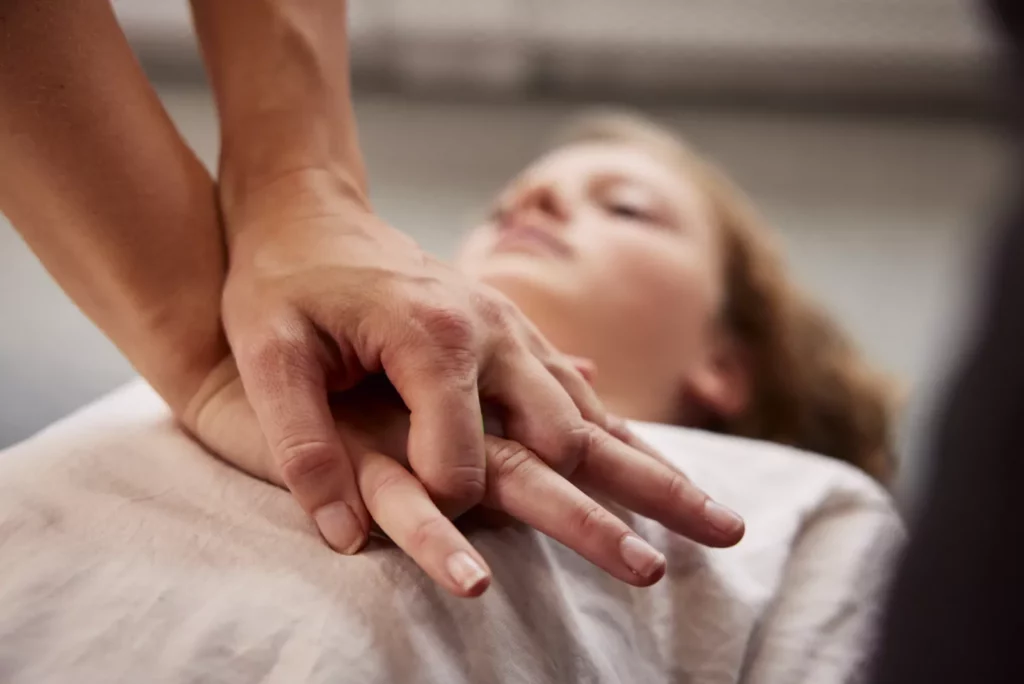
A significant and potentially deadly gender gap exists in the response to one of medicine’s most time-critical emergencies: women are far less likely to receive life-saving CPR from a bystander than men, with awkwardness, misplaced modesty, and fear of legal repercussions cited as key reasons for the hesitation.
Data reveals the stark reality. Thames Valley Air Ambulance reports that one in three women who suffer a cardiac arrest receive no CPR before emergency crews arrive. This aligns with a 2024 US study which found women were 27% less likely to receive CPR from strangers. In the UK, research by St John Ambulance found nearly a quarter of Britons admitted they were less likely to perform CPR on a woman in public, with a third of men specifically worried about being accused of “inappropriate” touching.
Why people hesitate to help
The reasons behind this disparity are complex but centre on societal discomfort. Amanda McLean, chief executive of Thames Valley Air Ambulance, states the issue is not that “bystanders don’t care, but because they hesitate,” adding that “modesty should never get in the way of saving a life.” The charity highlights that many people feel unsure about touching a woman’s chest, removing clothing, or cutting through a bra to apply defibrillator pads.
This discomfort extends directly to the use of defibrillators, which require pads to be placed on bare skin. St John Ambulance’s research indicates 38% of Britons feel uneasy about using a defibrillator on a woman, with nearly half of men less comfortable if it involved removing clothing, including a bra. Underlying this is a taboo around touching women’s breasts and, as the charity notes, a misguided belief that women are more fragile, alongside religious and cultural sensitivities.
Compounding these physical hesitations is a widespread fear of legal consequences. On social media, thousands have expressed anxiety about being sued for trying to help. Comments such as “I’m trained and confident with CPR, but I’m so scared of being sued” and “Sorry, but I refuse to get sued for trying to help someone” are common, indicating a significant barrier to public intervention.
Legal protections and building confidence
This legal fear persists despite robust protections in place. The SARAH (Social Action, Responsibility and Heroism) Act 2015 in England and Wales is designed specifically to reassure the public. According to the government, the act instructs courts to consider if a person was acting “responsibly and heroically” in an emergency, making it extremely unlikely for a Good Samaritan providing first aid to be successfully sued for negligence. Crucially, there have been no successful claims against first aiders in UK history.
To tackle the practical and psychological barriers, first-aid charities are adapting training. Some are now incorporating female mannequins with breasts to build confidence and normalise the procedure. East Anglian Air Ambulance (EAAA), which has trained 100,000 people since 2018, demonstrates techniques in sessions. Josh Lawrence, their community training programme manager, explicitly instructs how to ensure defibrillator pads make contact: “we can do that by either removing the bra completely, or moving the bra out of the way.” St John Ambulance emphasises that “every ‘body’ is the same” when it comes to CPR technique.
The need for this confidence is acute. In the UK, there are more than 40,000 out-of-hospital cardiac arrests annually, with an estimated survival rate of less than one in ten. Every minute without CPR and defibrillation reduces survival chance by up to 10%, whereas early intervention can more than double it. Despite this, public-access defibrillators are used in fewer than 10% of cases, and only 28% of UK adults would feel confident performing CPR. EAAA is targeting young people through a “Train the Trainer” scheme, aiming to equip the four in ten secondary students who currently leave school without this training.
Demographics reveal further context: two-thirds of these cardiac arrests occur in men, and around 80% happen in a person’s home. Survival rates show inequality beyond gender; research by the Resuscitation Council UK highlights disparities in CPR training access for ethnic minority groups and a lack of defibrillators in certain areas. For those who do not respond to standard CPR, advanced techniques like E-CPR (extracorporeal membrane oxygenation combined with CPR), offered in partnership by Thames Valley Air Ambulance and Harefield Hospital, are showing improved survival rates for eligible patients.