

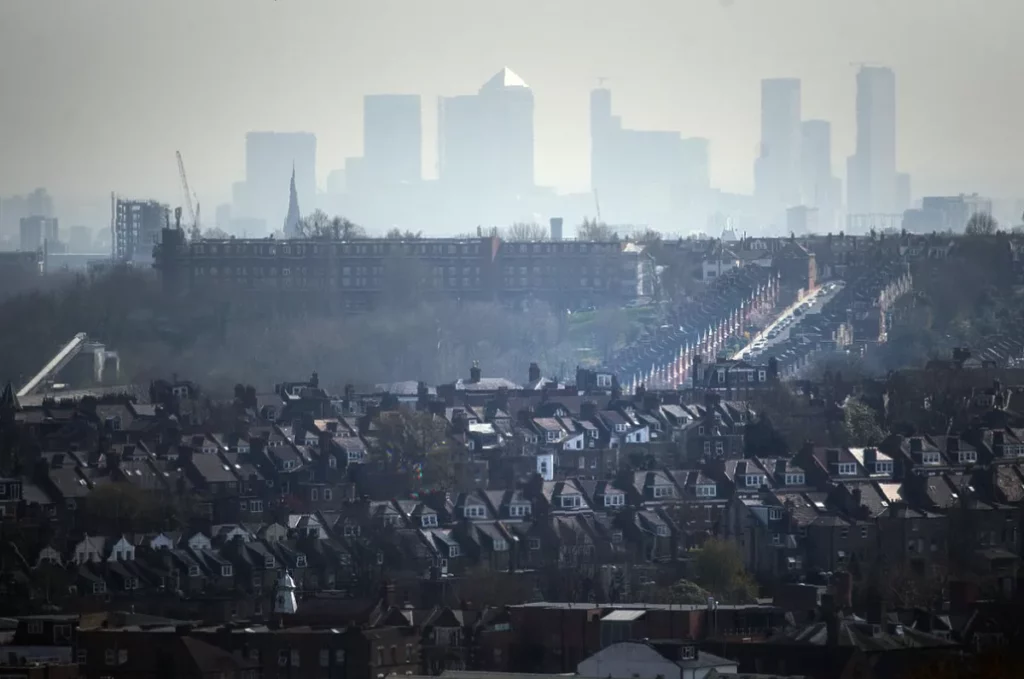
Exposure to air pollution is accelerating the onset of chronic illnesses in the UK, robbing people of their healthiest years by bringing forward conditions like dementia and Parkinson’s disease by two to five years, according to major new research.
The study, conducted by researchers from China’s Sun Yat-Sen University, Saint Louis University and the Chinese University of Hong Kong, analysed data from the UK Biobank. It examined more than 900,000 hospitalisation records from 396,000 Britons aged 39 to 70 who volunteered for the ongoing cohort study between 2006 and 2010. Tracking the first occurrence of 78 chronic illnesses, the researchers found that high exposure to air pollution was associated with an earlier onset for 48 of them—over 61 per cent.
While hypertension, diabetes, and asthma were the top three conditions whose onset was accelerated, the most pronounced effects were seen in neurological and psychiatric disorders.
How Pollution ‘Accelerates’ Brain Disease
The research found that disorders such as dystonia and myasthenia gravis manifested approximately two to five years earlier in those with high pollution exposure. The onset of schizophrenia was reduced by 2.4 to 3.8 per cent.
This acceleration is not just a statistical link but has a plausible biological mechanism. Research from Alzheimer’s Research UK highlights that fine particulate matter (PM2.5)—one of the most harmful pollutants—can be inhaled and deposited in the olfactory bulb, a region of the brain affected in the earliest stages of both Alzheimer’s and Parkinson’s disease. Separate studies have indicated that for every 10 µg/m³ increase in PM2.5, the relative risk of dementia rises by 17%, and that air pollution levels are linked to an increased risk of hospitalisation for people already living with these conditions.
This neurological impact is particularly significant in the UK context, where an estimated 944,000 people live with dementia—around 70,800 of whom have young-onset dementia, where symptoms begin under 65. For Parkinson’s disease, approximately 166,000 people are diagnosed, with one in 37 people alive today expected to be diagnosed in their lifetime.
A Broad and Costly Health Burden
The findings add a new dimension to the already substantial understood burden of dirty air. The Royal College of Physicians has warned that air pollution is estimated to contribute to the equivalent of 30,000 deaths in the UK annually, a figure projected to remain unchanged in 2025.
The economic cost is colossal. In 2019, healthcare costs, productivity losses and reduced quality of life linked to air pollution cost the UK upwards of £27 billion, with the government estimating between 29,000 and 43,000 equivalent deaths that year. The Royal College of Physicians suggests that when wider impacts like dementia are fully considered, this cost could reach £50 billion. Even with current policies, annual costs are projected to remain as high as £30 billion per year by 2040.
An earlier 2018 estimate placed the annual cost at £9-19 billion, comparable to the economic cost of obesity, while more recent analysis suggested the cost to the NHS and social care for diseases with strong evidence of a pollution link will be £1.6 billion between 2017 and 2025.
The Gap Between Targets and Reality
The World Health Organisation, which in 2021 called on countries to cut the “enormous health burden” from air pollution, has significantly tightened its guidelines. It now recommends an annual mean concentration of PM2.5 of just 5 µg/m³, down from 10 µg/m³ in 2005.
Under the Environment Act 2021, the UK has set legally binding targets to reduce PM2.5, aiming for a maximum annual mean concentration of 10 µg/m³ across England by 2040, alongside a 35% reduction in population exposure compared to 2018. Campaigners have criticised these as “weak” targets, arguing alignment with WHO guidelines is possible by 2030.
The scale of the challenge is underscored by data from the European Environment Agency, which reported in April 2025 that 94% of the EU’s urban population remains exposed to PM2.5 levels above WHO guidelines, despite an overall decline in pollution. The UK’s own statutory monitoring, via networks like the Automatic Urban and Rural Network (AURN), provides the data against which these targets are measured, with public reporting mandated by law.