

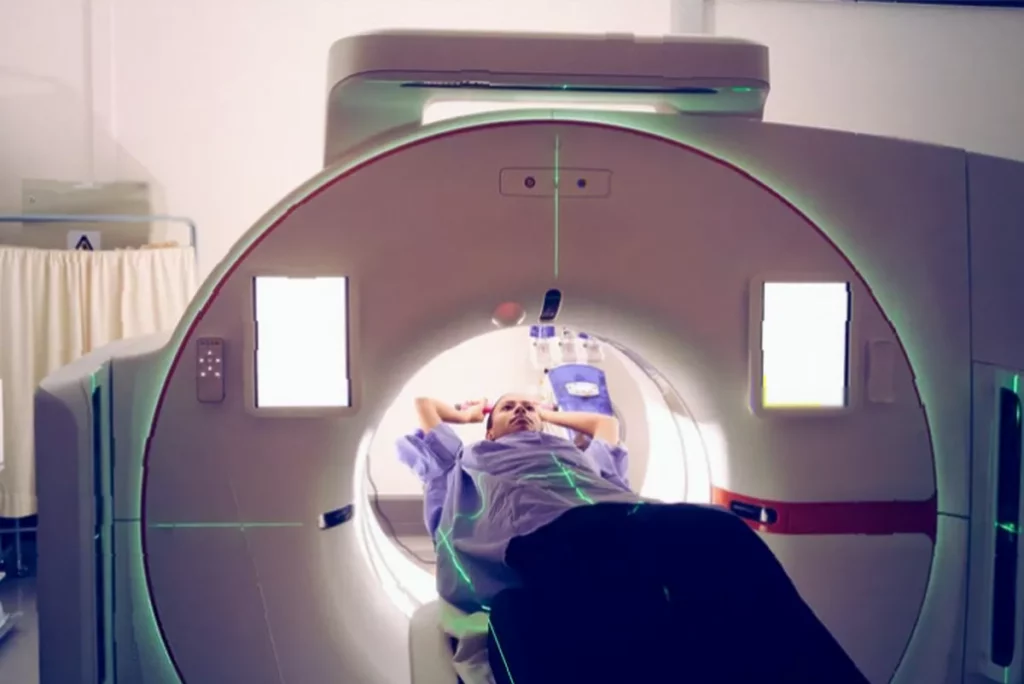
Artificial intelligence can spot the earliest warning signs of pancreatic cancer on CT scans as long as three years before a clinical diagnosis, according to a study published in the journal Gut by researchers at the Mayo Clinic.
The model, named the Radiomics-based Early Detection MODel (REDMOD), detected 73% of pre-diagnostic cancers at a median of about 16 months before doctors would normally find them. In a head-to-head comparison with board-certified radiologists, the AI proved significantly more sensitive — achieving 73% sensitivity compared with 38.9% for human reviewers. For scans taken more than two years before a formal diagnosis, the AI was nearly three times as effective, with a sensitivity of 68% against the radiologists’ 23%.
The technology works by identifying what researchers call “subvisual” patterns in the pancreas — minute textural disruptions in the organ’s tissue that are invisible to the human eye. Dr. Ajit Goenka, a Mayo Clinic radiologist and senior author of the study, explained that the model can detect abnormal cells that protect cancer from the immune system, a signature scientists have long recognised but struggled to visualise on standard imaging. “We knew, based on the biology of the disease, that this is not something which is coming all of a sudden in three months,” he said. “We knew that the signal was there. We just needed to find a way to be able to detect it.”
REDMOD analyses these “radiomic” features using an ensemble architecture that combines logistic regression, random forest and XGBoost classifiers, alongside fully automated volumetric pancreas segmentations. To manage class imbalance in the training data, the team employed a Synthetic Minority Over-sampling Technique (SMOTE), and the final model relies on a 40-feature radiomic signature. The system was trained on nearly 2,000 CT scans from multiple institutions, imaging systems and protocols, including scans from patients who were originally screened for unrelated conditions but later developed pancreatic cancer. The training cohort comprised 969 scans (156 pre-diagnostic and 813 control), and the model was tested on an independent set of 493 scans (63 pre-diagnostic and 430 control).
Dr. Daniel Jeong, a radiologist at Moffitt Cancer Center who was not involved in the research, acknowledged the limits of current manual review. “I analyse these images every day,” he said. “We’re really looking for a measurable mass that could represent the cancer. So these tumours need to grow to a certain level to become visible.” Pancreatic tumours are notoriously difficult to find because the organ lies deep within the abdomen, making physical exams ineffective. There is no routine screening available for the general public, and more than 85% of patients are diagnosed after the disease has already spread. The five-year survival rate for pancreatic cancer stands at just 13% overall; in the UK it drops to around 7.3%.
The AI model demonstrated strong longitudinal stability, with 90–92% concordance across multiple scans from the same patient taken months apart. Its predictions remained consistent over time, and it showed generalisable specificity across multi-institutional datasets (81.3%) and public datasets (87.5%). In one of the machine-learning classifiers used, a support vector machine achieved a sensitivity of 95.5% and an AUC of 0.98, significantly outperforming radiologists whose mean AUC was 0.66.
Despite these promising results, researchers caution that REDMOD is not yet ready for widespread clinical use. The tool is currently being evaluated in a clinical trial that requires three to five years of patient monitoring to confirm its accuracy in real-time. Experts also note that the study population lacked ethnic diversity, which limits how far the findings can be generalised. “In a disease where we have been just wandering in darkness for decades, this is a milestone that shows us the finish line, but we still have to get to the finish line,” Goenka said.
If the technology proves out, researchers suggest it could eventually serve as a triage tool for high-risk individuals — those with a family history of the disease, new-onset diabetes, chronic pancreatitis, or other known risk factors such as smoking (linked to 20–22% of UK cases) and obesity (10–12%). The ability to shift diagnoses from late-stage to early-stage disease is critical: patients diagnosed at Stage 1 or 2 have a five-year survival rate of up to 29%, compared with the single-digit rates seen once the cancer has spread.
The study joins several recent advances in the field, including early-stage trials for mRNA vaccines and experimental drugs that have shown promise in extending life expectancy for advanced cases, as well as other early-detection efforts such as blood tests showing over 95% accuracy in early trials, urine tests using biomarkers LYVE1, REG1B and TFF1, and an AI tool that predicts pancreatic cancer from electronic health records up to three years ahead.