

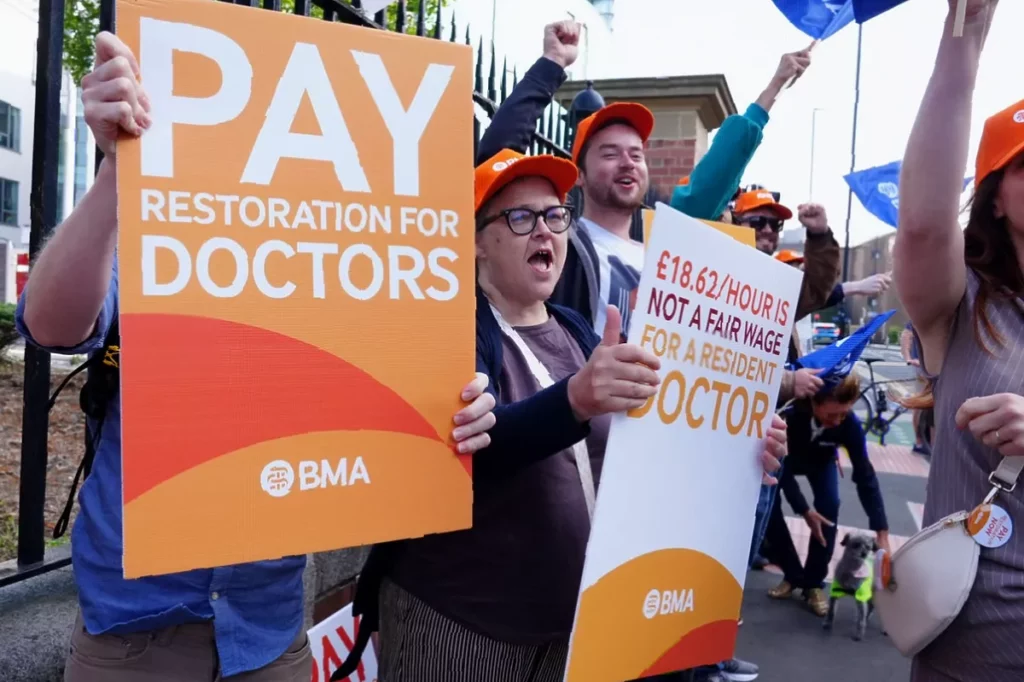
Doctors are poised to commence a six-day strike immediately after the Easter bank holiday, with the government threatening to withdraw thousands of promised NHS training posts if the action is not called off within 48 hours. The British Medical Association (BMA) has rejected the latest pay offer, pushing the long-running dispute over pay restoration to the brink once more.
Starmer brands strike decision “reckless”
Prime Minister Sir Keir Starmer has issued a direct 48-hour ultimatum to the BMA, branding its committee’s decision to reject the government’s pay and conditions package as “reckless”. Writing in The Times, Sir Keir warned that the NHS would face further damage if the fresh strikes, scheduled from 7 to 13 April, proceed. “Walking away from this deal is the wrong decision… And doing so without even giving resident doctors themselves the chance to vote on it makes it even worse,” he stated, urging the union to put the deal to its members.
Sir Keir argued that no one would benefit from rejecting the agreement, warning that resident doctors would forgo improved pay and reforms, the NHS would incur crippling costs for strike cover, and patients would bear the impact of further disruption. The forthcoming strike will be the 15th by resident doctors since the dispute began in March 2023, and is set to be the joint-longest walkout in this period.
The BMA’s core demand and the rejected offer
The central demand from the BMA remains “full pay restoration” to 2008 levels, which the union calculates represents a 26% increase. The union argues that real-terms pay has fallen by over a fifth since 2008, a figure it bases on the Retail Price Index (RPI) measure of inflation. This long-term pay erosion, despite recent uplifts, is the fundamental grievance driving the industrial action.
Last week, the BMA’s resident doctors committee rejected a government offer that included a pay rise of up to 7.1% for the current year. The government had stated that this offer, developed in partnership with the BMA, would have meant a starting salary for new graduates nearly £12,000 higher than in 2022-23. For the most experienced resident doctors, basic pay would have risen to £77,348, with average earnings exceeding £100,000. First-year doctors would have earned an average of £52,000, with the lowest-paid receiving increases of at least 6.2% and 7.1% in their first two years.
Beyond pay, the deal included the creation of 4,000 to 4,500 additional specialty training posts over the next three years—with 1,000 brought forward for an April recruitment round—aimed at addressing job competition for UK medical graduates. It also contained reforms to pay progression, reimbursement for Royal College exam fees, and improved contracts for Locally Employed Doctors (LEDs). The government emphasised that resident doctors have already received an average 28.9% pay rise over the last three years, following a deal agreed in September 2024 that provided a 22.3% uplift over two years.
However, Dr Jack Fletcher, chair of the BMA’s resident doctor committee, accused the government of “moving the goalposts” during negotiations. He claimed late changes were made to reduce the investment and stretch it over a longer period. Dr Fletcher stated that any government-imposed “deadline disappears the moment there is a credible and sustainable offer on the table,” and expressed a willingness to continue talks.
Government’s stark counter-threat on jobs and future deals
In response to the rejection, the government has made a stark counter-threat. Sir Keir Starmer and Health Secretary Wes Streeting have warned that the offer of thousands of additional training posts will be withdrawn if the strikes are not called off. Mr Streeting told the Commons, “There is not a something for nothing culture here,” signalling that the posts were contingent on the deal’s acceptance.
The government also warned that future pay offers may be less generous if the current deal is withdrawn, citing the immense financial cost of continued industrial action. Each strike day is estimated to cost the NHS approximately £250 million, with some NHS leaders warning the figure can reach £300 million per strike, diverting funds from patient care. The total cost of NHS strikes since April 2023 has been estimated at around £1.7 billion.
Mr Streeting indicated the government’s financial flexibility was constrained, partly due to the need to plan for a “prolonged conflict” in Iran. He also noted recent significant public sector pay rises as a factor limiting further increases for doctors. The government has passed the Medical Training Prioritisation Act to favour UK-trained doctors for specialty posts, a commitment in its 10-year health plan for England.
Mounting impact on patients and the health service
The cumulative impact of the strikes is substantial. Since the end of 2022, at least 1.7 million healthcare appointments have been rescheduled due to industrial action across the NHS. During strikes in July 2025 alone, 54,095 appointments were postponed. NHS providers report that this action negatively impacts waiting lists and can cause significant distress, pain, and worsening health for patients.
NHS bosses have previously accused resident doctors of seeking to cause “maximum harm” by timing strikes during busy periods. There are also concerns that industrial action has potentially contributed to patient deaths, though establishing a direct causal link is difficult. The strikes also place considerable moral and psychological strain on staff who are not striking but must maintain essential services.
The dispute occurs against the backdrop of an official change in terminology from “junior doctors” to “resident doctors” across the UK from September 2024, intended to better reflect their expertise and role. Historically, NHS doctor strikes were rare, with significant national walkouts occurring in 1975 and 2016, before the current period of intensified industrial action.