

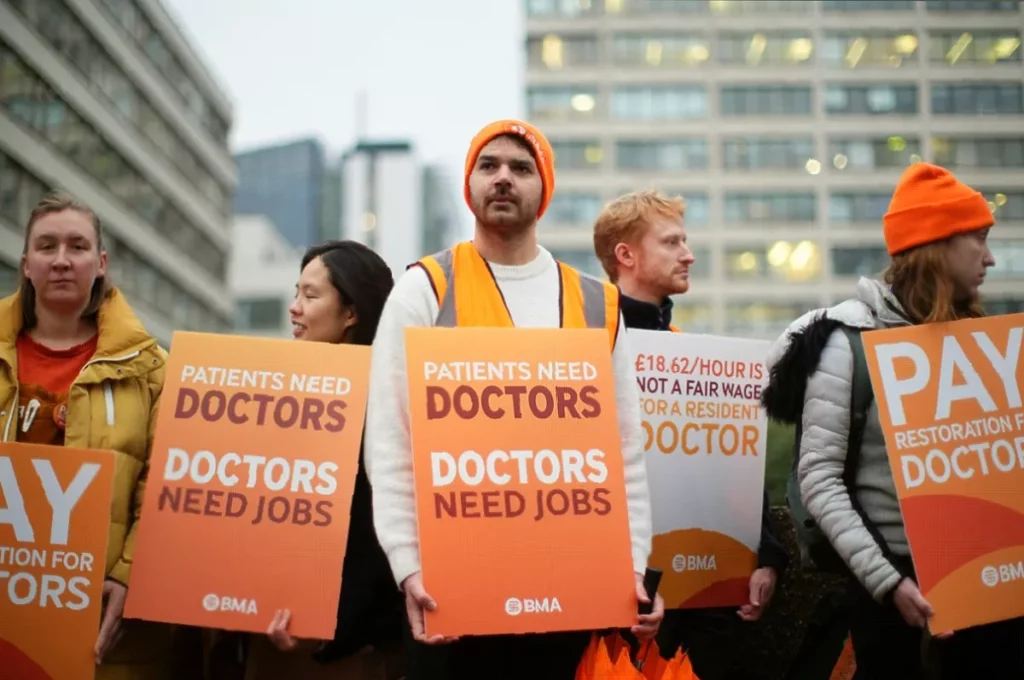
The NHS is braced for weeks of patient chaos as a result of a six-day strike by resident doctors, set to begin immediately after the Easter bank holiday weekend. Health service leaders warn the unprecedented length of the walkout, combined with its timing and new legal constraints, will create a disruption that will ripple through appointments and surgeries for weeks to come.
A “sting in the tail” from timing and law
This latest industrial action – the 15th in a dispute that began in March 2023 – is scheduled from 7am on Tuesday, 7 April, to 7am on Monday, 13 April. Its immediate proximity to the Easter break is a critical aggravating factor. Rory Deighton, acute and community care director for the NHS Alliance, said the service has “precious little time to prepare,” with the holiday “adding to the challenge of adapting services, arranging cover, and then getting back to business as usual in the days and weeks that follow.”
Compounding this is a recent law change, which means unions must give only 10 days’ notice of strike action, rather than the previous period. NHS leaders told The Independent this shorter window makes planning “much harder,” a difficulty magnified when it encompasses a bank holiday. “Operational teams would normally be planning how to maintain safe, urgent, and emergency care over this period, but they now have to plan for a further six days of industrial action immediately after, so 10 days of disruption in total,” one leader said.
The strain is not confined to the strike days. Mr Deighton warned of a “sting in the tail,” as staff drafted in to cover the walkout will subsequently need to take leave, prolonging the backlog. Since late 2022, at least 1.7 million NHS appointments have been rescheduled due to strikes, with 54,095 acute appointments moved in July 2025 alone. Each round of action is estimated to cost the NHS around £250 million, with a five-day walkout last July estimated at £300 million.
Fractures within the profession as talks collapse
The strike proceeds after a collapse in negotiations between the government and the British Medical Association (BMA). The core dispute remains pay restoration, with resident doctors seeking to reverse what they see as a long-term real-terms pay cut since 2008. The government had offered an average pay increase of 4.9% this year, which it said would make salaries 35.2% higher on average than four years ago, alongside measures on training.
However, the BMA rejected this, stating the proposal fell short on pay, job clarity, and worker protections, and accused ministers of “shifting the goalposts” by reducing the pay investment and spreading increases over three years. Dr Jack Fletcher, chair of the BMA’s resident doctors committee, said he would “happily” meet ministers over Easter to avert the strike, but that the offer did not meet the threshold to put to members.
In response, the government has withdrawn a key part of its proposal: an offer of 1,000 additional specialty training places. A government statement said this was no longer considered “financially or operationally” possible after the BMA confirmed the strike. Health Secretary Wes Streeting questioned whether the BMA was “serious about reaching an agreement at all,” adding that “good faith cannot run in only one direction.”
This hardening of positions is mirrored by growing weariness among some senior doctors. One consultant told The Independent the “BMA is trying to put me in an early grave,” while another said they were “fed up,” suggesting the timing seemed “designed to cause the most disruption.” They also reported that not all resident doctors participated in the last round of strikes.
Strategic shift and lasting consequences
The cumulative impact of the strikes is prompting a fundamental strategic rethink within the NHS. Sir Jim Mackey, chief executive of NHS England, has said the service will accelerate plans to design clinical models that are less reliant on resident doctors, not as a threat but to ensure reliability. This involves expanding multidisciplinary teams and giving greater responsibility to advanced practitioners, nurses, and other health professionals.
Sir Jim anticipates a “long slog” of industrial action potentially lasting up to a further 12 months if no deal is reached. The strain on non-striking staff is significant, with annual leave often cancelled and staff experiencing moral distress from having to cancel appointments. Research into the 2016 junior doctor strikes found that while overall emergency patient outcomes did not worsen, Black patients experienced worse outcomes in more exposed hospitals, highlighting the complex and unequal impacts of such actions.
For now, NHS England has urged patients to attend planned appointments unless contacted to reschedule. It has assured the public that hospital teams will work to minimise disruption and that emergency services remain open. Those with life-threatening conditions should still call 999 or attend A&E, while NHS 111 online or by phone should be used for urgent advice.