

Satisfaction with the NHS has risen for the first time in seven years, offering a glimmer of hope for a service that has endured prolonged decline. Figures show public approval across England, Scotland, and Wales increased to 26% in 2025, up from an all-time low of 21% the previous year, while dissatisfaction saw its largest drop since 1998, falling from 59% to 51%.
Streeting’s prescription: A list of improvements
Health Secretary Wes Streeting seized on this shift in mood during a recent address, presenting it as evidence that Labour’s treatment is beginning to revive the NHS. In a buoyant performance, he listed what he termed the fruits of his 20-month tenure: a reduction of 374,000 in the treatment backlog, the best winter A&E performance for four years, and the fastest ambulance response times for heart attack and stroke victims in five years. He claimed the government had delivered 2,000 extra GPs against a promise of 1,000, alongside more mental health staff, dentistry appointments, and a £26bn funding increase for England’s health service.
On key targets, Mr Streeting told his audience that waits for planned hospital treatment would definitely meet the 18-week standard by 2029. He later expressed broader confidence, suggesting success on all critical metrics including A&E, cancer care, and ambulance response times was within reach.
The other reality: “The worst few weeks of my career”
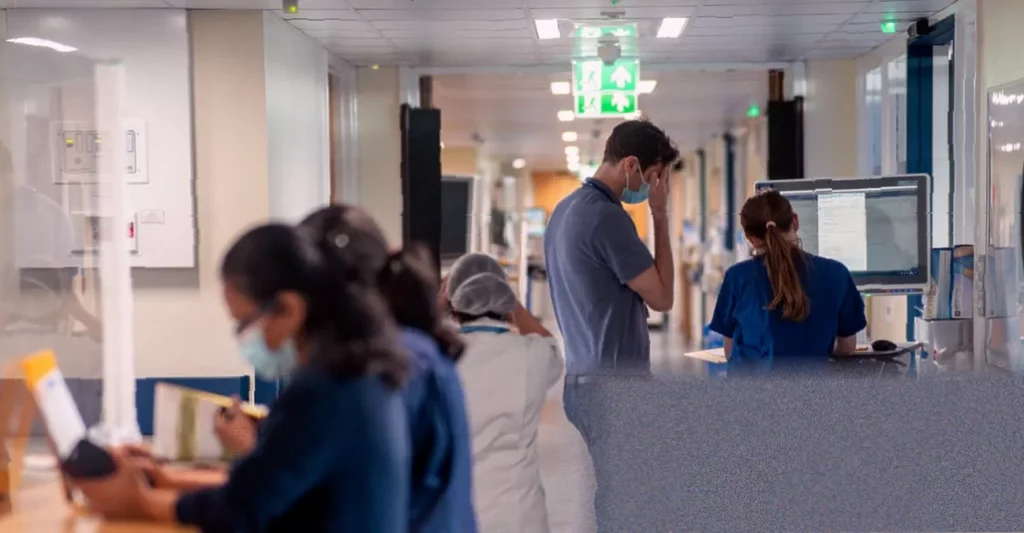
Yet, as Mr Streeting spoke, a very different reality was unfolding 150 miles away at Leighton Hospital in Crewe. Despite winter being over, the hospital faced intense pressure, with its emergency department at breaking point. At one stage it was caring for a near-record 170 patients while 110 others who were medically fit for discharge remained on wards, compounding the crisis in A&E.
One staff member described it as the worst period of their career. “You could see the despair on everyone’s faces,” they said. “There were just no answers as there was no space anywhere for patients.” Mr Streeting himself has acknowledged this duality, stating he is both “proud of our progress” and “often ashamed when confronted with the reality of an NHS that still isn’t there for people when they need it.”
Research by University College London’s Global Business School for Health, based on 850 NHS leaders, underscores the fragile state of the system. It found that while staff goodwill remains, “people are exhausted.” Relentless demand and constrained resources mean the service is operating dangerously close to the line, with high vacancy rates consuming management time simply to ensure services are safely staffed.
The high-risk gamble: Restructuring the NHS
The greatest threat to Mr Streeting’s agenda, however, may lie not in day-to-day pressures but in his own radical structural reforms. Having previously ruled it out, the Health Secretary is now pursuing the abolition of NHS England, the arms-length body created in 2013 to manage the service, and its merger with the Department of Health and Social Care (DHSC).
Stuart Hoddinott, an NHS expert at the Institute for Government, understands the rationale, noting that NHS England often duplicated DHSC functions and limited the health secretary’s direct power. However, he is sharply critical of the execution. “It was an incredibly hasty decision that seems to have been made with little consideration of the wide-ranging impacts,” Mr Hoddinott said. “It is creating a lot of turmoil.”
The legislation required to enact this merger remains unpublished, a point highlighted by Bill Morgan, a former health adviser to Rishi Sunak, who called the reorganisation “a total car crash.” The human and financial cost is significant, involving halving the staff of the DHSC, NHS England, and the 42 regional Integrated Care Boards. More fundamentally, Mr Hoddinott warns of a distracted and dispirited workforce, too consumed by a “chaotic” restructuring to deliver the Health Secretary’s core priorities.
Slow progress on the “big shifts” and missed targets
Those priorities are encapsulated in Mr Streeting’s 10-year plan, which promises “three big shifts”: from analogue to digital, from treatment to prevention, and from hospital to community care. NHS insiders report progress is slow, with plans far outstripping delivery. “I can’t yet hear the sound of the machinery of the ‘three big shifts’ clanking into gear,” one senior figure said.
A tangible example is the pledge to create new “neighbourhood health centres,” intended to unite services under one roof closer to home. The government aims for 250 by 2035, with the first 27 in deprived areas by 2027. Yet, fulfilling this is both an operational and political challenge.
Meanwhile, underlying performance data paints a mixed picture. While the overall NHS vacancy rate fell to 6.7% in September 2025 from 8.4% two years prior, staff retention remains a critical issue. On specific targets, the NHS is at risk of missing key goals. In January 2026, only 61.5% of patients were seen within 18 weeks for planned treatment, below the 65% interim target for March 2026. Analysis suggests that even with sustained effort, the official 92% target by 2029 may be out of reach.
Ambulance response times for Category 2 calls, like heart attacks and strokes, averaged 47 minutes in December 2024, breaching the 30-minute target for 2024/25. And while public satisfaction has risen, it remains low for specific services: just 22% for A&E, 27% for GP appointments, and 16% for hospital appointments. Notably, 71% of the public believe there are not enough NHS staff.
Mr Hoddinott of the Institute for Government summarises the dichotomy: while there have been improvements in hospitals and general practice, these gains are undermined by a “disordered strategy for reforming the NHS.” The success of Mr Streeting’s tenure may ultimately hinge on whether a destabilising reorganisation derails the fragile recovery he claims is now underway.