

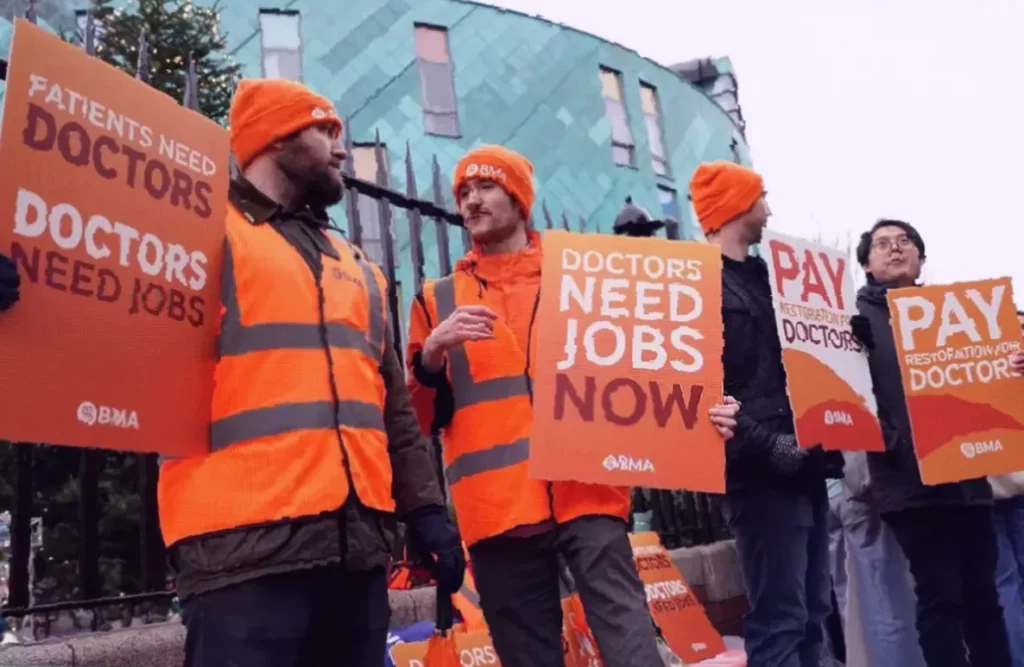
Doctors in England will stage a six-day walkout in April in an escalating dispute over pay and conditions, their union has announced, after accusing the government of shifting the goalposts in negotiations.
Strike Dates Set for Early April
The British Medical Association (BMA) has confirmed its resident doctor members will strike from 7am on Tuesday 7 April until 6:59am on Monday 13 April 2026. This latest round of industrial action follows a five-day strike in December 2025 and reignites a dispute that first began in March 2023.
Dr Jack Fletcher, chair of the BMA’s Resident Doctors Committee, stated that talks had been progressing well until, in the last two weeks, the government “began to shift the goalposts”. Dr Fletcher, an acute medicine doctor from the North East, said the union had been negotiating in good faith to end what it describes as simultaneous pay and jobs crises.
Pay Offer “Spread Over Three Years” Sparks Anger
The central point of contention is the structure of the government’s latest pay offer. The BMA says it became clear during talks that proposed money for pay increases was to be spread over three years, a move the union argues will not substantially address years of pay erosion.
This comes alongside the latest recommendation from the independent Review Body on Doctors’ and Dentists’ Remuneration (DDRB), which has advised a 3.5% pay uplift for doctors from April 2026. The government has accepted this recommendation for a consolidated 3.5% increase for consultants, SAS doctors, resident doctors, and locally employed doctors.
However, the BMA highlights that the Retail Prices Index (RPI) measure of inflation stood at 3.6% for the 12 months to February 2026, meaning the recommended uplift represents another real-terms pay cut. The union states resident doctors have seen their pay fall by approximately 26% in real terms since 2008/09, and its stated aim remains “pay restoration”. Dr Fletcher made clear that “any deal that did not move us substantially in that direction was not going to fly.”
The dispute persists despite a complex recent history of settlements. In September 2024, resident doctors in England voted to accept a government pay offer averaging a 22.3% increase over two years. Furthermore, in May 2025, they were offered an average rise of 5.4% for 2025-26, which the government described as the highest public sector award that year. This followed a previously accepted deal resulting in an average increase of 28.9% over the three years up to 2025-26.
The BMA argues the current offer of a 3.5% rise for 2026/27, phased over three years alongside additional training posts and exam fee reimbursements, is insufficient. The union warns that economic indicators point to years of increased inflation, making any offer that risks further pay erosion unacceptable.
The context of pay scales adds further detail. As of late 2025, a first-year foundation doctor (FY1) had a basic salary of £38,831, with estimated total NHS earnings around £45,900. The average full-time basic pay for resident doctors was expected to reach approximately £54,300 in 2025-26.
Government Response and Broader NHS Impact
The government, through Health Secretary Wes Streeting, has been involved in negotiations and has offered potential improvements to previous offers. Its position rests on the acceptance of the DDRB’s independent recommendation.
The strike action is set to cause significant disruption to NHS services. Since the end of 2022, NHS England data shows at least 1.7 million healthcare appointments have been rescheduled due to industrial action. A retrospective study of a 2012 strike found a 45.5% increase in cancelled outpatient appointments and a 12.8% decrease in elective admissions on the strike day.
While mortality rates for patients admitted to hospital have not been shown to be significantly different on strike days in previous analyses, there have been reports linking disruption to patient deaths. The NHS has, however, developed mitigation strategies; during a five-day strike in November 2025, it maintained over 95% of planned elective activity.
The dispute unfolds against a backdrop of a strained NHS workforce. As of November 2025, the NHS in England employed approximately 1.55 million people (full-time equivalent), but faced an estimated 100,000 vacancies as of August 2025. Staff dissatisfaction remains high, with 43% of NHS staff dissatisfied with pay in the 2024 NHS Staff Survey.
Despite the strike announcement, the BMA has stated it is “not closing the door on talks” and remains willing to negotiate if the “early positive spirit of negotiations” can be recaptured.