

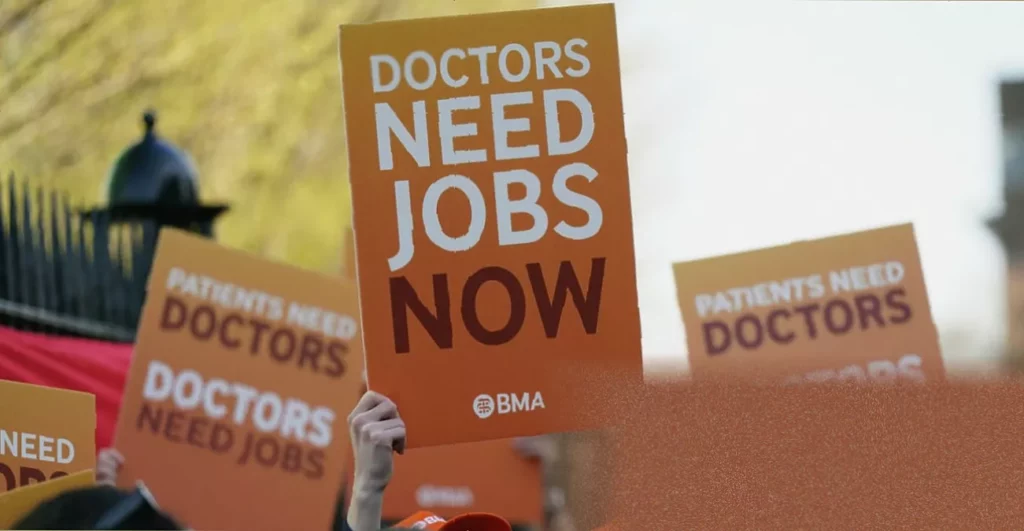
The head of the NHS has accused resident doctors of deliberately timing their latest six-day strike to coincide with the Easter holidays in order to “cause havoc” across the health service. Sir Jim Mackey, chief executive of NHS England, said hospitals had struggled to fill rotas after the holiday weekend, with many staff already on leave, intensifying the disruption of the walkout.
In a letter to health service managers, Sir Jim said the action by the British Medical Association’s (BMA) resident doctors committee was “really disappointing” and risked setting back recent progress on waiting times. He thanked staff for their efforts in maintaining services, noting that the NHS aimed to keep 95% of planned care going during strikes. “We cannot forget this action has been deliberately timed to cause havoc,” he stated.
Mounting Cost and Disruption
This strike, which began on Tuesday, 7 April 2026, is the longest yet in a dispute that has seen 15 rounds of industrial action since March 2023. The financial toll is mounting; the current six-day stoppage is estimated to cost £300 million, adding to a total bill from resident doctors’ strikes that exceeds £3 billion. Previous walkouts have led to the cancellation and rescheduling of an estimated 507,000 appointments and operations between July 2023 and February 2024.
While urgent, emergency, cancer, and maternity care are being prioritised, NHS leaders have urged patients to attend appointments unless told otherwise. Some analyses have suggested emergency department flow can improve during strikes due to the focus on acute care, but other evidence points to a negative impact on waiting lists overall.
The Core of the Pay Dispute
At the heart of the conflict is the BMA’s demand for what it calls “full pay restoration.” The union argues that real-terms salaries have eroded drastically since 2008 and is seeking a 26% pay rise over the coming years. Analyses of the pay cut vary, with some suggesting a real-terms decline of as much as 21% since 2008/09, though other estimates are lower.
The government, however, has highlighted that resident doctors have received a significant pay rise, with salaries now averaging 35.2% higher than four years ago. Its latest offer was a 3.5% increase for 2026/27, which the BMA rejected as insufficient. Health Secretary Wes Streeting has defended the government’s position, stating its offer represented “the limits of what is affordable, deliverable and fair to patients and taxpayers”.
Talks broke down in late March over two key issues. The first was the timing of a £700 million package for “progression pay,” which is linked to doctors moving more quickly through their pay bands. The BMA claims the Department of Health and Social Care (DHSC) reneged on an agreement by proposing to spread this money over three years instead of providing it sooner. Secondly, the government withdrew an offer of 1,000 additional specialty training posts, stating it was no longer “financially or operationally” possible after the BMA rejected the deal and called strikes.
Announcing the strike, Dr Jack Fletcher, chair of the BMA’s resident doctors committee, accused the government of shifting the goalposts after talks had been “making good progress.” The union also frames the dispute as being about career progression, citing a “bottleneck” in applications for specialty training posts.
Stalemate and Strategic Shifts
Mr Streeting has claimed the BMA’s rejection “torpedoed” pay rises and training posts for its own members. Meanwhile, Sir Jim Mackey has warned that the NHS could face strikes “every four weeks” for the next year if the dispute escalates, prompting a strategic rethink. He said the health service should become “less reliant on a transient training workforce,” with NHS England considering how to build services around a “more blended clinical family.”
The BMA itself is not immune to internal industrial strife, facing accusations of hypocrisy as its own staff are on strike over a below-inflation 2.75% pay rise. The union has said budget pressures prevent it from offering its employees more.
The situation remains a stalemate. While a deal was accepted by BMA members in September 2024, temporarily halting the dispute, the underlying grievances have clearly resurfaced, leaving patients and the NHS bracing for further disruption amid one of the most protracted industrial disputes in the health service’s history.