

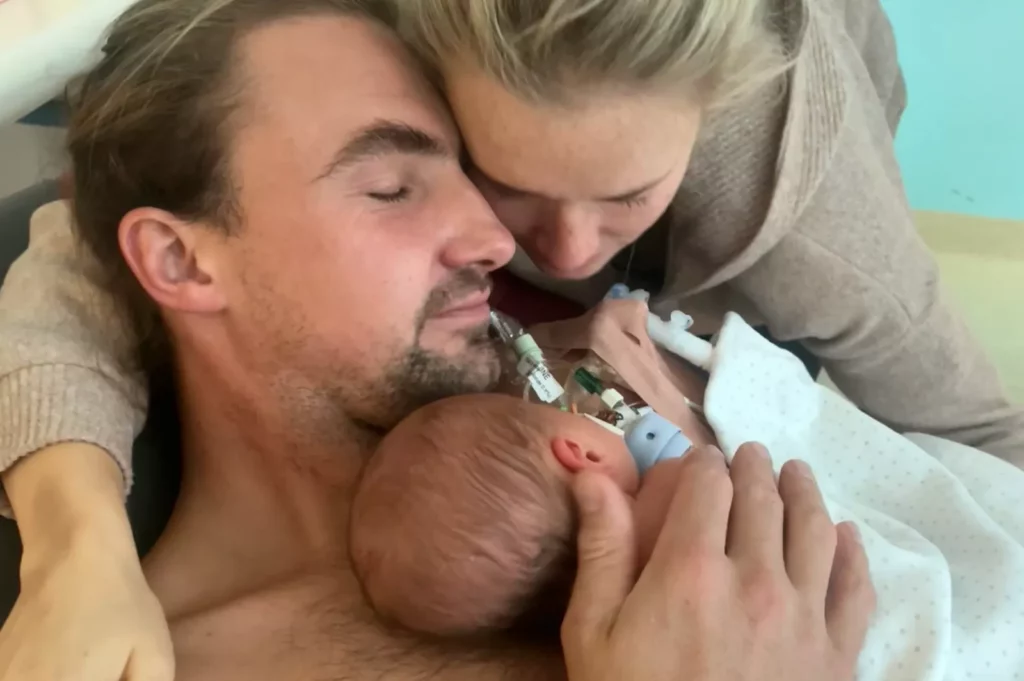
A midwife admitted at an inquest that an ambulance should have been summoned 90 minutes before a baby was born “blue and floppy” at a home birth, a failure which lies at the centre of a case raising urgent questions about the safety of high-risk deliveries outside of hospital.
The admission from midwife Sasha Field was read to Barnet Coroner’s Court, which is examining the death of seven-day-old Poppy Hope Lomas on 26 October 2022. Ms Field’s written statement, presented by Senior Coroner Andrew Walker, aligned with a finding by the Healthcare Safety Investigation Branch (HSIB). She said the call should have been made when a slowdown in the baby’s heart rate was detected after a contraction. In reality, Poppy’s father, Jason Lomas, was told to call 999 at approximately 10.37pm, just two minutes after her birth, by which time she showed no signs of life.
‘A horrific memory that sticks in my mind’
The baby’s mother, Gemma Lomas from Enfield, told the inquest she was actively encouraged to have a vaginal birth after caesarean (VBAC) at home by Alice Boardman, the head midwife of Edgware Midwives. This is the designated home birth team at Barnet Hospital, part of the Royal Free London NHS Foundation Trust.
Ms Lomas, whose first daughter was born by caesarean in 2018, claimed she was not made aware of the risks of a home VBAC. She described the moment after the birth, stating: “The midwife placed Poppy on my chest and said, ‘There’s your baby’. Poppy was blue and floppy. There was blood coming out of her mouth and her head fell back. That’s a horrific memory that sticks in my mind, being handed my dead baby.” She further alleged that the midwives present were slow to respond and lacked urgency.
The inherent risks of a home VBAC
Coroner Andrew Walker suggested to midwife Sasha Field that Ms Lomas “should never have been made to deliver her baby at home,” telling her: “There is an argument you shouldn’t have been put in a position to deliver a high-risk birth without the necessary equipment available at hospital.” This observation is supported by established medical guidance.
According to the Royal College of Obstetricians and Gynaecologists (RCOG), VBACs should be conducted in a “suitably staffed and equipped delivery suite” and “with resources available for immediate caesarean delivery.” While VBAC is generally safe for many women, it carries specific risks, chief among them uterine rupture, which occurs in approximately 0.5% (or 1 in 200) of planned VBAC labours. This rare but serious complication requires immediate surgical intervention to prevent catastrophic outcomes for mother and baby, an intervention impossible to provide in a home setting.
The case emerges amid a national review of home birth services ordered by NHS England, prompted by mounting concerns over inconsistent care, staffing pressures, and a series of serious incidents. Coroners have repeatedly raised concerns about home birth safety since 2022, citing issues like missed fetal distress and delays in emergency transfer. Many NHS trusts have suspended or restricted services due to staffing shortages, creating a postcode lottery for care.
Coroner points to systemic concerns
In his remarks, Senior Coroner Walker highlighted the systemic dilemma faced by front-line staff, telling Ms Field, “You did the best you could in the circumstances.” His comments point to a wider context where midwives may be placed in untenable situations without the hospital facilities that professional guidelines deem essential for higher-risk births like VBAC.
The inquest also heard evidence regarding the severity of Poppy’s condition. She was transferred to University College Hospital, London, where she was treated by consultant neonatologist Dr Giles Kendall. Dr Kendall, an honorary associate professor at UCL’s EGA Institute for Women’s Health with a research focus on neonatal brain injury, reportedly described Poppy’s brain scan as “one of the worst that he’d seen in his career.”
The inquest was adjourned until Wednesday, when evidence is expected from Dr Kendall. The proceedings continue to scrutinise the chain of events, from the initial advice given to the parents to the emergency response after Poppy’s birth.