

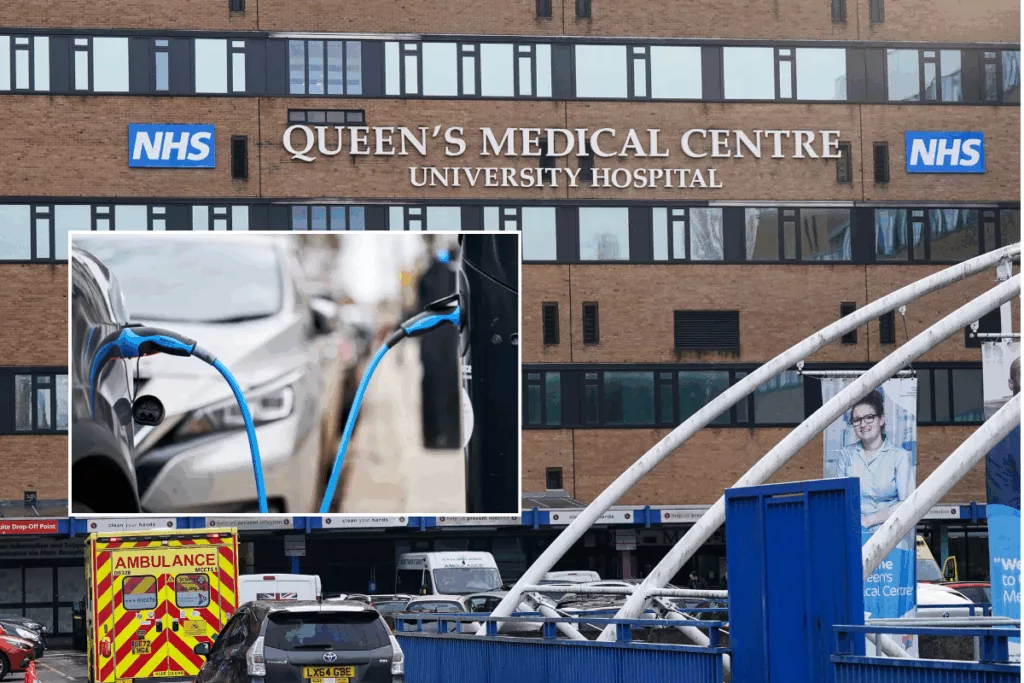
More than three-quarters of NHS hospital sites in England are still without any electric vehicle charging points, leaving staff, patients and visitors who drive electric cars facing significant practical difficulties.
Analysis of NHS Estates Returns Information Collection data by online car retailer Cinch found that 2,231 out of 2,901 hospital sites – 76.9 per cent – currently offer no charging facilities at all. Across the entire NHS estate, there are fewer than 5,000 chargers in total.
While some regions have made headway, the distribution remains deeply uneven. The North East and Yorkshire has the highest number of chargers – 1,098 spread across 450 sites – yet even there, nearly seven in ten sites (69 per cent) have none. At the other end of the scale, the South West has only 277 chargers across 285 sites, leaving 82 per cent of locations without any provision.
Other regions fare little better. In the Midlands, 80 per cent of hospital sites lack chargers; in the East of England it is 79 per cent; London 78 per cent; the North West 77 per cent; and the South East 72 per cent.
A handful of NHS trusts account for a disproportionately large share of the existing infrastructure. West Hertfordshire Teaching Hospitals NHS Trust leads with 129 chargers, followed by Northumbria Healthcare NHS Foundation Trust (120), Milton Keynes University Hospital NHS Foundation Trust (101), South Tyneside and Sunderland NHS Foundation Trust (95), and Liverpool University Hospitals NHS Foundation Trust (88).

Yet several major trusts still report no charging facilities at all, including Nottingham University Hospitals NHS Trust, Gloucestershire Hospitals NHS Foundation Trust, University Hospitals of Leicester NHS Trust, United Lincolnshire Teaching Hospitals NHS Trust, and Wirral University Teaching Hospital NHS Foundation Trust.
Motoring expert Ben Welham from Cinch said the figures revealed a mixed picture. “It’s encouraging to see some regions and trusts making progress, with over 1,000 chargers in the North East and Yorkshire,” he said. “That shows investment is happening, but the challenge now is making sure it’s spread more evenly so electric car drivers can benefit. It’s surprising to see some major hospital trusts still reporting no EV charging at all, particularly when they operate multiple sites.”
Practical problems for staff, patients and visitors
The absence of on-site charging creates real-world difficulties for the thousands of people who travel to hospitals every day. NHS staff typically work long shifts, often stretching beyond eight or twelve hours, leaving little opportunity to find alternative charging points nearby. For patients and visitors attending appointments, the need to rely on a car – whether for mobility, convenience or lack of public transport – makes the lack of charging a source of additional stress.
Without chargers at the hospital, drivers must plan their journeys more carefully, seek out public charging points en route or nearby, and risk arriving with insufficient battery for the return trip. As Welham put it: “For staff, patients and their visitors, knowing you’ll be able to charge up when you’re there is one less thing to worry about.”
The problem is set to intensify as the UK pushes towards the government’s Zero Emission Vehicle mandate, which requires all new car sales to be electric by 2030, with an interim target of at least 33 per cent electric by the end of this year. “As more drivers switch to electric vehicles, expanding charging in everyday locations like hospitals is a key element of making that transition easy,” Welham added.

Government schemes are attempting to address the gap. The NHS Chargepoint Accelerator Scheme, launched with £8 million in 2024 and extended by a further £4 million in February 2026, brings total government investment in NHS charging infrastructure to £22 million. Separate funding is being directed at electrifying the NHS’s 20,000-strong fleet of medical vehicles, aiming to decarbonise 460 million miles of travel annually and save millions in fuel and maintenance costs.
Yet the rollout faces significant obstacles. Some NHS trusts report insufficient electrical capacity to support the number of charging units they forecast needing. The process from initial conversation to operational chargers can take up to two years. Sustainability leads may lack education on the available options, leading to indecision, while issues such as bays being blocked by non-charging vehicles and unclear access rules hinder effective management. Navigating funding routes – including the LEVI Fund, the workplace charging scheme, and the NHS-specific accelerator scheme – adds further complexity for estates managers.
Broader concerns also dog the public charging network, which now numbers more than 116,000 chargers nationally but faces reliability problems (US data suggests around 78 per cent reliability) and inconsistent pricing described by some as a “Wild West”. The government has introduced regulations requiring 99 per cent reliability for rapid chargers and clearer payment methods, but these rules do not yet cover all NHS on-site chargers.
For now, the vast majority of NHS hospital sites remain without any electric vehicle charging, leaving those who work, seek care, or visit loved ones to navigate a patchy and uncertain infrastructure. The gap between the handful of trusts leading the way and the hundreds that have not yet installed a single charger underscores how far the health service still has to go.