

A federal judge’s ruling has left the United States without a functioning national vaccine advisory committee, creating immediate uncertainty for immunisation policy and throwing the nation’s public health infrastructure into disarray.
Court Blocks Appointments, Invalidate Votes
The crisis stems from a ruling by a federal judge in Massachusetts on March 16, which issued a preliminary injunction against the Department of Health and Human Services. The judge found that HHS Secretary Robert F. Kennedy Jr.’s appointment of 13 new members to the Advisory Committee on Immunization Practices (ACIP) last year likely violated federal law by not ensuring a “fair balance” of viewpoints or adhering to the committee’s charter requirements for expertise.
The decision effectively blocks those appointments and invalidates all votes taken by the reconstituted panel. This legal blow, stemming from a lawsuit brought by medical societies led by the American Academy of Pediatrics (AAP), means the committee now lacks a quorum to operate. The judge emphasised that national vaccine policy should be guided by “rigorous, evidence-based science, not politics.”
Secretary Kennedy had dismissed all 17 previous members of the long-standing ACIP in June 2025, citing concerns about “conflicts of interest” and a desire to restore public trust, arguing the committee had become a “rubber stamp.” He subsequently appointed eight new members, including individuals with histories of vaccine scepticism.
Malone’s Exit and Committee Disarray
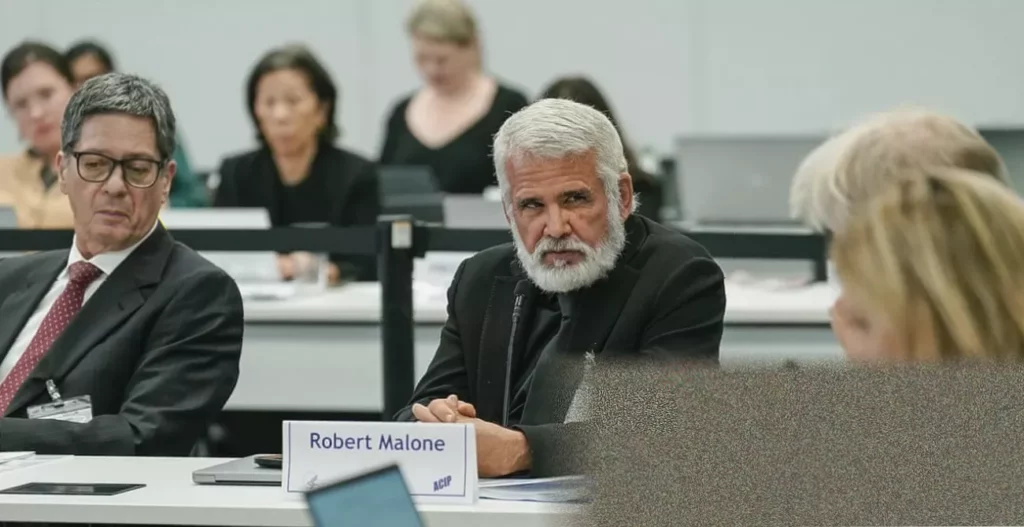
Amid the upheaval, one of the most controversial appointees, physician Robert Malone, has announced his departure. Malone, who has incorrectly claimed vaccines are dangerous and ineffective and was once banned from Twitter for allegedly spreading misinformation, stated he was “done with the CDC and ACIP.”
He attributed his decision to unpaid labour, “incredible hate,” and “sabotage,” telling the New York Times he would decline to participate in any relaunched committee. Malone had previously claimed the ACIP was “disbanded,” an assertion flatly rejected by HHS spokesperson Andrew Nixon, who called such statements “baseless speculation.” Malone cited Nixon “trashing” him in the press as “the last straw.”
Another Kennedy appointee, Joseph Hibbeln, welcomed a shift in focus. “It is better to make public health decisions based on data, not drama,” Hibbeln said, adding that drama distracts from preparing for future pandemic threats.
Impact on Vaccines and a Liability Limbo
The immediate practical effect of the court’s ruling is that the US vaccine schedules for children and adults have reverted to those in place before Kennedy’s overhaul. This restores the schedule of 17 routine childhood vaccinations and overturns specific controversial decisions, such as a downgraded recommendation for the Hepatitis B vaccine at birth.
However, significant problems remain. Recommendations for annually updated vaccines, like the latest flu and Covid-19 shots, are now in limbo, as the invalidated committee had been tasked with reviewing them. While these immunisations remain federally authorised and on the market, their administration faces potential hurdles.
A critical issue involves pharmacist liability. Under the Public Readiness and Emergency Preparedness (PREP) Act, physicians and pharmacists are protected from liability when administering Covid-19 vaccines specifically if they follow CDC and ACIP recommendations. With the ACIP non-functional, that shield is compromised for Covid shots. The PREP Act declaration, extended through December 2029, also covers pharmacists administering flu vaccines.
This creates a patchwork of risk. Some states allow pharmacists to administer vaccines endorsed by outside bodies like the AAP, but others have limits if the ACIP does not recommend them. Given that pharmacists administer an estimated 64% of adult flu vaccines and nearly 90% of all Covid-19 vaccines, the uncertainty could significantly impact access.
The instability extends beyond the committee. The Centers for Disease Control and Prevention is now on its fourth leader in approximately a year, with current acting director Jay Bhattacharya also running the National Institutes of Health. This leadership churn raises concerns about the agency’s capacity to manage future health threats.
Appeal Planned as Process Restarts
The Department of Health and Human Services has signalled it will fight the ruling. Spokesperson Andrew Nixon said the department “looks forward to this judge’s decision being overturned,” though no official appeal announcement has been made.
Regardless of the appeal, the process to reconstitute the committee is lengthy, taking an estimated four to six months. Richard Hughes IV, a lawyer representing the AAP in the lawsuit, made clear that any future appointments would be scrutinised, stating, “We will challenge anything short of a qualified committee selected through the proper process.”
Within HHS, Martin Kulldorff, the former chair of the reconstituted ACIP and a critic of past Covid-19 policy, now serves as chief science officer in a planning office, acting as an internal adviser to Secretary Kennedy. Commenting on Malone’s exit, Kulldorff said he could “sympathize with his decision to step away” given the court ruling and the volunteer nature of the work.