

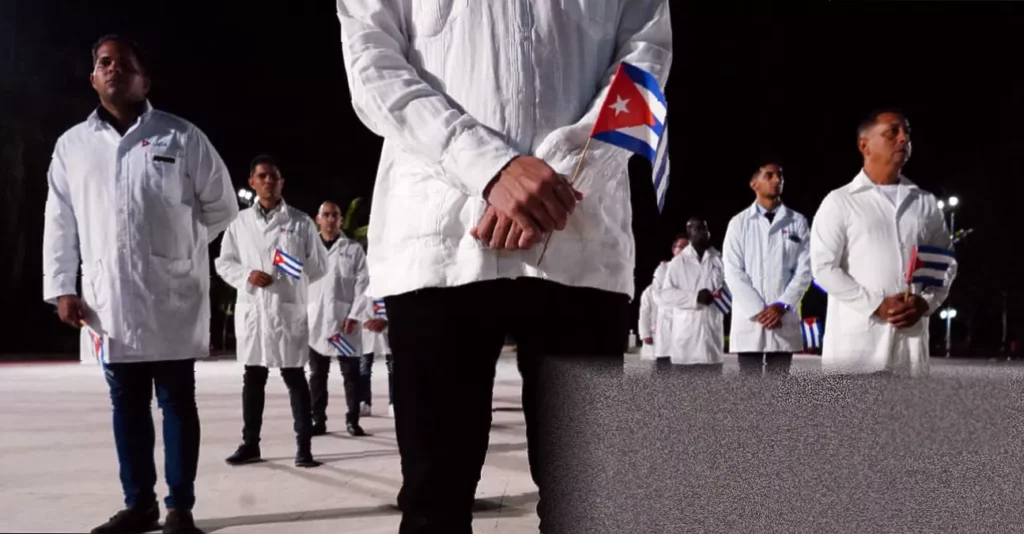
Cuba has accused the United States of “extorting” governments across Latin America to cancel long-standing agreements for the supply of Cuban doctors, a move it claims is a deliberate attempt to strangle the island’s economy.
Foreign Minister Bruno Rodríguez made the allegation, stating that the US government was “persecuting, pressuring, and extorting other governments to end the presence of Cuban Medical Brigades in various countries, under false pretenses.” The decades-old medical missions are a pivotal source of revenue and national pride for Havana, projected to generate $7bn in earnings last year for the cash-strapped nation.
US Pressure and Economic Warfare
Rodríguez’s accusation forms part of a broader condemnation of what Cuba views as a US campaign of “maximum pressure” on its communist regime, a policy intensified under the former US President Donald Trump. The US strategy aims to cut off a critical financial lifeline for Cuba, which is already teetering on the edge of economic collapse due in part to a comprehensive US energy blockade and tightened sanctions.
This pressure has yielded results. According to reports, several countries seeking to maintain strong ties with Washington have terminated their medical partnerships. Guatemala, Honduras, Jamaica, and Guyana have all ended their agreements with Havana. US Secretary of State Marco Rubio has been a vocal critic, describing the Cuban doctor program as “basically human trafficking.” As part of its efforts, the US State Department has also imposed visa restrictions on officials from third countries involved in the program.
Allegations of Forced Labour and Human Trafficking
The core of the US argument, supported by international human rights bodies, is that Cuba’s medical missions constitute a system of forced labour and human trafficking. A report published this week by the Inter-American Commission on Human Rights (IACHR) denounces serious human rights violations within the program.
The IACHR president, Edgar Stuardo Ralón, stated in an interview that some practices could be classified as “forced labour” and “human trafficking.” The allegations, echoed by organisations like Human Rights Watch and the Human Rights Foundation, include a pattern of control and coercion. The report accuses Cuban authorities of withholding the vast majority of doctors’ wages, with medics receiving only between 2.5% and 25% of what host countries pay Cuba for their services.
Further, the IACHR report and other investigations detail how doctors’ passports and medical credentials are routinely confiscated, their private lives subject to surveillance. Participation is allegedly not always voluntary, with evidence of coercion and threats of retaliation against medical personnel and their families. Doctors have reported being threatened with prison sentences of up to eight years if they defect or abandon their posts abroad.
Cuba has consistently and vehemently denied these allegations. President Miguel Díaz-Canel asserts that doctors receive their full salary and additional compensation and that their participation is voluntary. The government defends the program as an act of “solidarity” designed to bring essential health services to remote, hard-to-reach places in partner nations.
Scale of the Missions and Regional Context
The dispute centres on a program of enormous scale. Official figures indicate that about 24,000 Cuban doctors and healthcare professionals were deployed across 56 countries last year, with most sent to remote areas. Historically, over six decades, Cuba has deployed more than 600,000 healthcare professionals to at least 165 countries, beginning with a brigade to Algeria in 1963.
The program’s geopolitical dimension is starkly illustrated in Venezuela, Cuba’s key ally for a quarter of a century. As of last year, half of all deployed Cuban medics were stationed there. This deployment preceded the reported abduction of Venezuelan President Nicolás Maduro by US forces in January, an operation conducted as part of “Operation Absolute Resolve.”
The US pressure campaign on the medical missions continues under the current administration, with the Biden government largely maintaining the restrictive policies enacted by its predecessor. For Cuba, the missions represent both a crucial economic pillar and a fundamental element of its foreign policy, making the escalating US pressure a direct challenge to its statecraft and survival.