

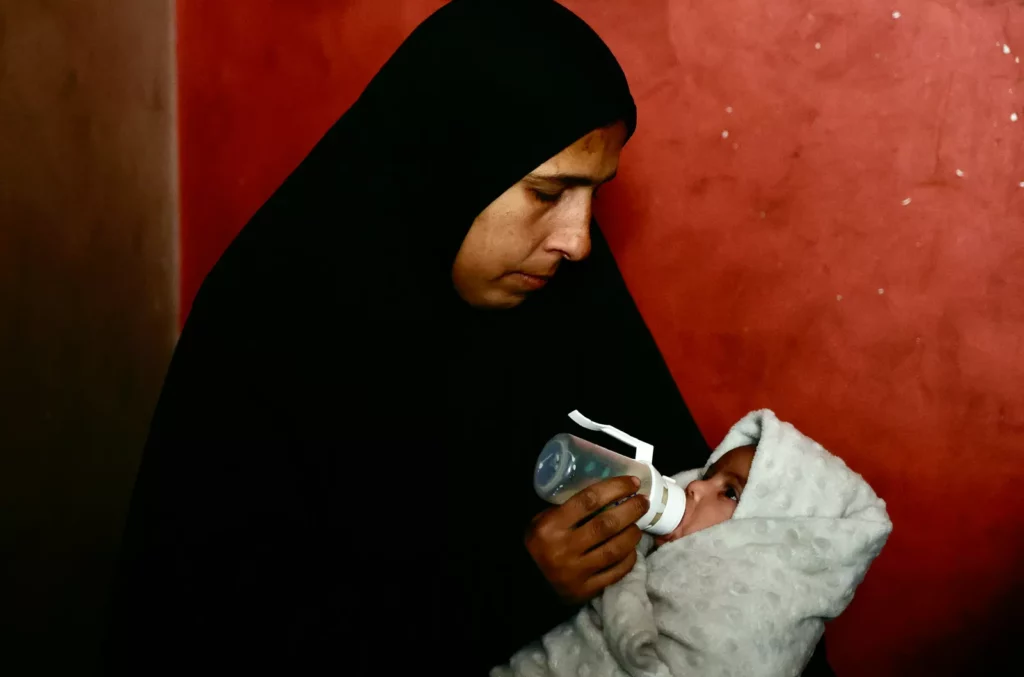
When Raneen’s contractions began, she phoned for an ambulance. The dispatcher told her the service was for injured people only, not for women giving birth. With no other option, a neighbour found a horse-drawn cart to carry her through the rubble-strewn streets of Khan Younis, where she struggled to breathe between the jolts and the pain. Her daughter was born into a war that had already claimed her son and left her husband too ill to work.
Raneen had spent her pregnancy malnourished, anaemic and short of vitamins – conditions that have become routine for pregnant women in Gaza. “Our suffering is immense,” she said. “My daughter was born amid this tragedy.” Months later, she found Wefaq, a women-led organisation, through word of mouth. They gave her a mattress and access to a psychotherapist. Raneen is one of 50,000 people the group has supported this year – more than double the number it reached before the war.
Wefaq’s Struggle to Keep Going
Wefaq provides legal aid, psychosocial care, a gender-based violence hotline and humanitarian assistance. But its ability to meet soaring demand has been severely undermined by the US aid freeze. A five-year programme supported by the United States Agency for International Development (USAID), worth roughly $1m (£734,000) a year, was cut entirely in early 2025, according to Wefaq. The cut came as part of Donald Trump’s dismantling of the agency during his second presidential term – a move that dissolved USAID and terminated 5,800 contract awards and 4,100 State Department grants. Over $383m in USAID funding to the Palestinian Territories was frozen as of March 2025, according to agency records.
“Suddenly, everything stopped. It was a very difficult period,” said Buthaina Subeh, Wefaq’s director. “If that project had continued, the scale and quality of services would have been very different.” Wefaq found other funders and kept going, but at reduced capacity, absorbing a surge in need with a fraction of its former resources. The US State Department has been contacted for comment on the cuts.
The funding crisis has forced other aid groups to scale down or shut down entirely. The International Medical Corps laid off approximately 700 staff members and now offers only basic services at hospitals. ActionAid Ireland reported that its partner Wefaq was forced to evacuate and dismantle its operations in Deir Al Balah due to escalating Israeli activity, critically curtailing its ability to deliver essential services to displaced women and families.
The Collapse of Legal Recourse for Women
The need for support continues to balloon because the institutions women would normally turn to are also gone. Gaza’s Sharia courts held exclusive jurisdiction over divorce, custody, inheritance and guardianship. A 2025 report by the Palestinian Centre for Human Rights (PCHR) documented the near-total collapse of the system: courts and archives destroyed, thousands of legal case files lost, judges and staff killed or displaced. At a UN human rights hearing in March this year, a representative of Palestinian women’s organisations said dispute resolution had been pushed into displacement camps and makeshift mediation sessions “even under the rubble.”
Into that vacuum, violence has moved. Randa, a lawyer working with Wefaq through ActionAid, said that after the judicial headquarters were destroyed in airstrikes, the courts were suspended entirely, leaving women with no recourse to access their rights. “This war has helped men evade giving women their rights, because of the absence of police and courts,” she said. “So many men have stopped granting rights to women, such as expenses or child support.” She takes calls from women who need divorces, who have not received child support in over a year, who cannot enforce custody arrangements that predate the war.
The consequences of this legal vacuum are stark. There are now believed to be at least 22,000 widows in Gaza, with some estimates suggesting one in seven families is now headed by a woman. Women’s unemployment stands at more than 92 per cent – far higher than the 81 per cent recorded for men. As of May 2026, the Gaza Health Ministry reported more than 72,000 Palestinian deaths since the conflict began. A disproportionate number of those killed are women and children. Some 85 per cent of the population has been forcibly displaced.
The Palestinian Centre for Human Rights alleges that the targeting of Sharia courts forms part of a systematic Israeli policy to dismantle Palestinian institutional and legal structures. Israel has repeatedly denied this, and says it does not target civilians or civilian infrastructure.
A Broader Crisis for Women’s Rights
Nisreen, one of Wefaq’s psychotherapists, runs sessions from a tent with a two-month-old baby. She describes women arriving unable to concentrate because of malnutrition, some fainting in the room. “Many showed clear signs of trauma, many carried deep feelings of guilt – thinking that if they had kept their children at home, or stopped their husbands from going out, they would still be alive,” she said. “The hardest part of our work is that so often we are both the client and the service provider at the same time.”
Women’s rights organisations globally receive less than one per cent of humanitarian and gender-focused aid funding, according to UN Women. A UN Women report found that 90 per cent of women’s organisations surveyed in crisis-affected countries have been impacted by foreign aid cuts, with almost half expecting to shut down within six months. UN Women itself invested $623m in 2024 across 109 countries. Yet in Gaza, over 500,000 women and girls lack access to reproductive health care, and pregnant women face triple the risk compared to a year ago because of famine, lack of water and inadequate medical care. Only 11 of Gaza’s 36 hospitals are partially functional. Al-Awda Hospital in northern Gaza, the only facility providing maternity services, has faced repeated bombing campaigns and the arrest of its manager.
The USAID money that reached Wefaq kept lawyers employed and services running for women who had nowhere else to go. Nisreen, who now lives in a tent herself, said: “I now live in a tent that is neither safe nor able to provide security or protection. These are all things we have now lost.”