

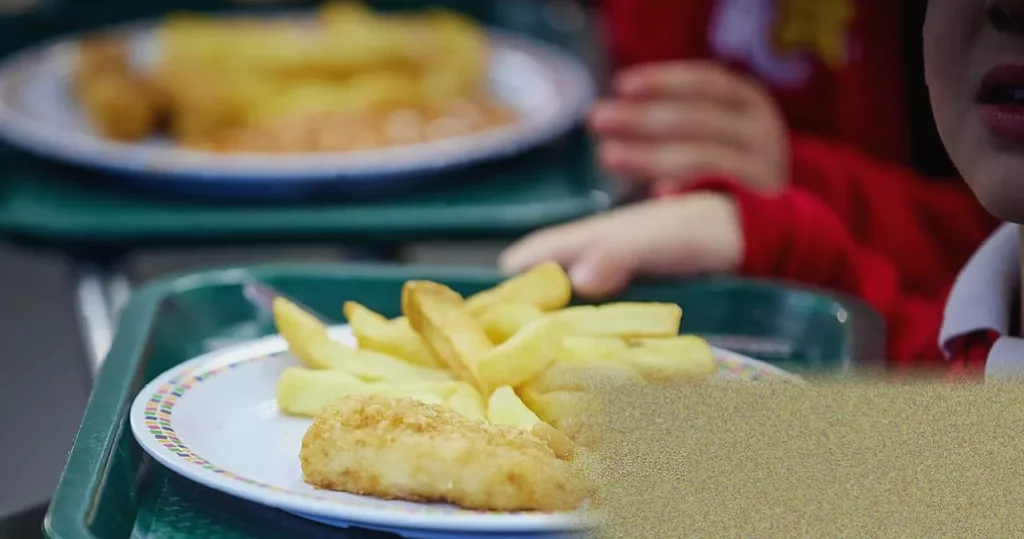
England’s school dinners are set for their biggest shake-up in over a decade, with classic but calorific staples like fish and chips and steamed sponge puddings facing the axe under new government rules.
New Rules Target Fried Food and Sugary Puddings
The first major update to school food standards in 13 years will see all deep-fried items, including battered fish and chicken nuggets, banned. Furthermore, all school puddings will be required to contain at least 50% fruit, putting traditional desserts like jam doughnuts and steamed sponges in doubt. The changes, described by Education Secretary Bridget Phillipson as “the most ambitious overhaul of school food in a generation,” will apply to all school breakfasts and lunches. They are scheduled to come into force this September, with full enforcement expected by September 2027. Secondary schools will have an extra year to implement changes for ‘grab and go’ options.
The move represents a significant tightening of the current rules, which allow schools to serve two portions of deep-fried food per week and desserts with less than 50% fruit on three days. The Department for Education developed the new standards in conjunction with nutritionists and public health experts.
Focus on Enforcement to Tackle a “Grab-and-Go Culture”
Central to the overhaul is a new national enforcement regime designed to ensure compliance, addressing long-standing criticisms that previous standards were inconsistently applied. The government intends for every school to appoint a lead governor with specific responsibility for school food. Crucially, schools will be required to make their food policies and daily menus publicly available, giving parents direct oversight of what is being served.
Campaigners have welcomed this focus on accountability. D’Arcy Williams, CEO of the youth-led campaign group Bite Back, stated that without proper monitoring, previous standards “haven’t been consistently enforced,” allowing a “grab-and-go culture” where convenience often trumps nutrition. Henry Dimbleby, co-author of the 2013 School Food Plan, said the changes offered “a rare chance to reset school food,” but stressed they would only work with “proper monitoring to help schools improve what ends up on the plate.”
Obesity Data Underpins Urgent Reforms
The driving force behind the reforms is the persistent challenge of childhood obesity. NHS data released in January 2024 showed that 24% of nursery and primary school children in England were overweight or living with obesity. More recent figures from November 2024 indicate that 9.6% of reception-aged children (4-5 years old) were obese in 2023/24. While obesity rates for Year 6 pupils (10-11 years old) fell to 22.1%, this remains higher than pre-pandemic levels. The prevalence increases with age, affecting 17% of 13-15 year olds in 2024. The NHS spends approximately £6.5 billion annually on treating obesity-related ill health.
Excess sugar consumption is a particular concern. Research indicates children consume around twice the recommended amount of ‘free’ sugars, a major contributor to tooth decay—the leading cause of hospital admissions for children aged five to nine.
Historical Context and the Academic Case for Better Food
The fight for better school food has a long history. Following Jamie Oliver’s “Feed Me Better” campaign in the mid-2000s, which targeted products like ‘Turkey Twizzlers’, the government reintroduced mandatory food- and nutrient-based standards around 2008/2009. This reversed a decline seen in the 1980s when catering services were privatised and nutritional standards removed.
Studies have linked improved meal quality directly to educational outcomes. Research following Oliver’s 2004 campaign found improvements in pupils’ test results and reduced absences. Nutrients like Omega-3s, iron, and vitamins are essential for brain function, with evidence suggesting better academic performance in children with higher Omega-3 levels.
Coalition Launches to Support Schools with Transition
To help schools implement the new standards, five leading education and food organisations have formed the School Food Project. The partnership, comprising Bite Back, Chefs in Schools, Jamie Oliver Group, School Food Matters and The Food Foundation, has raised £2.3m and aims to launch in September 2026. It will provide practical support to help schools produce healthier, better-quality meals.
Chef and campaigner Jamie Oliver, who two decades ago controversially claimed “dog food had higher standards than school dinners,” said he was “delighted this government is now updating and enforcing” the rules. He described school food as the “most important restaurant chain” in the country, noting that during term-time, schools will provide two-thirds of a child’s daily diet. A nine-week public consultation on the detailed reforms is set to begin.