

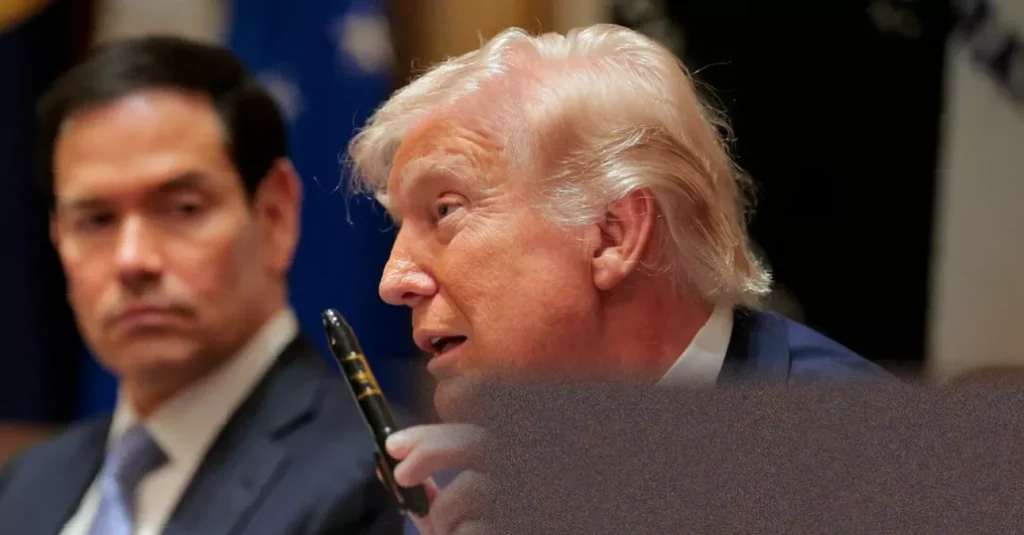
Donald Trump has dismissed the United Kingdom’s two flagship aircraft carriers as little more than “toys” compared to American naval power, reviving his criticism of NATO allies for what he claims was a failure to support the US at the outset of the conflict with Iran.
The former president made the remarks during a wide-ranging address at the start of a White House cabinet meeting. He claimed that “three weeks ago” the UK had offered to send its carriers, HMS Queen Elizabeth and HMS Prince of Wales, but only “when the war is over.” Trump stated he told them: “Don’t bother. We don’t need it.”
Downing Street has repeatedly and categorically denied that any such offer to deploy the carriers was made. The Queen Elizabeth-class carriers are the largest warships ever constructed for the Royal Navy, each displacing around 65,000 tonnes and designed to project continuous carrier strike capability with their squadrons of F-35B Lightning II aircraft.
Starmer’s response and the state visit
Prime Minister Keir Starmer, asked earlier this week about Trump’s repeated criticisms of the UK, suggested they were designed to exert political pressure. He told MPs his response was to focus on his job and act in the national interest. Trump, for his part, has called Starmer a “lovely man” but accused him of “shocking” behaviour in not assisting the US over Iran.
Despite the diplomatic friction, Trump insisted that a planned state visit to the US by King Charles III and Queen Camilla would go ahead. The visit, expected in Spring 2026 around the time of the US’s 250th Independence anniversary, is set to include an address to Congress and a state dinner at the White House.
UK settles post-Brexit bill and tackles fuel poverty
Separate government data released today revealed the scale of the UK’s financial settlement following its departure from the European Union. The Treasury reported that more than £25 billion has been paid to the EU since 2020 under the terms of the withdrawal agreement, which covered outstanding liabilities. The final estimated cost is now put at £30.9 billion, lower than original projections of between £35bn and £39bn.
There was also positive news on living costs, as the Department for Energy Security and Net Zero published figures showing a fall in fuel poverty in England during 2025. An estimated 9.4% of households, or 2.36 million, were classified as fuel poor under the government’s Low Income Low Energy Efficiency (LILEE) metric, down from 9.9% the previous year.
The department said the reduction was driven by the expansion of the Warm Home Discount scheme from 2025/26, energy efficiency improvements, and lower energy prices. Peter Smith, director of policy at National Energy Action, welcomed the progress but warned it was “far too slow,” particularly for owner-occupiers, and that current trends could mean it taking two decades to meet legal targets on fuel poverty.
The latest poverty statistics incorporate a new methodology, using actual administrative records of benefit receipts rather than survey responses. The Institute for Fiscal Studies noted this change has produced lower headline poverty rates but cautioned it is too early to say if this reflects a genuine decrease.
Whitehall efficiency drive and other developments
In a move to streamline government, the Cabinet Office announced plans to “rip up consultation culture” by reducing bureaucratic reporting and consultation requirements. Measures include using AI to identify disproportionate duties and replacing Environmental Impact Assessments with new Environmental Outcomes Reports for infrastructure projects. In a written statement, Cabinet Office Minister Nick Thomas-Symonds described the initiative as “sludgebusting.”
However, consultations have not ended entirely; the Department for Environment, Food and Rural Affairs has simultaneously launched a public consultation on banning trail hunting.
In other news, Defence Minister Luke Pollard announced that 884 former members of Afghan special forces units, known as the “Triples,” have had their resettlement applications overturned and will now be eligible to stay in the UK under the Afghan Relocation and Assistance Policy (Arap). Ministers have also pledged record spending on road maintenance as part of a new £27 billion five-year investment plan for England’s strategic road network.
Scandals and controversies in the parties
Reform UK has faced renewed scrutiny over its candidates. The party’s leader, Nigel Farage, suggested in a BBC interview that former MP James McMurdock could be allowed to rejoin the party. McMurdock, who was convicted of assault in 2006 and is under investigation for allegedly facilitating racial abuse online, left Reform last year following separate allegations about his business conduct during the pandemic. A Labour spokesperson said the potential return of McMurdock showed Reform “cannot be trusted to uphold the high standards expected in public life.”
In Wales, a Reform candidate for the Senedd, Corey Edwards, has apologised after a photograph emerged of him making a Nazi salute. Edwards stated his grandfather fought the Nazis and that he is a “staunch champion of Judaism.”
In Scotland, Conservative leader Russell Findlay launched his campaign by stating his party is the only one that “fundamentally supports the union,” criticising the SNP’s push for independence and accusing Reform of not being a true unionist party.
Finally, the chief executive of National Savings and Investments, Dax Harkins, has stepped down. His departure follows the revelation that NS&I failed to trace accounts of deceased customers, leaving an estimated £470 million in missing savings owed to around 37,500 people. Sir Jim Harra has been appointed interim chief executive.