

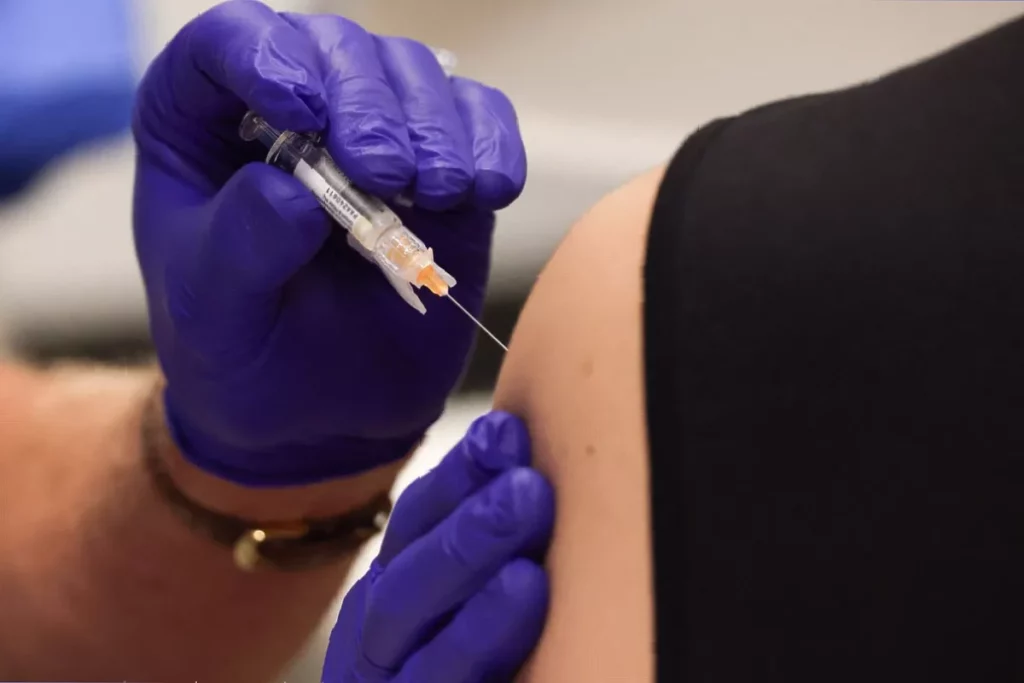
Nearly half of American adults doubt the settled science on vaccines, viewing the facts as still up for debate, a major new poll has revealed, underscoring a profound and politicised shift in public trust that is now shaping federal health policy.
The survey, conducted in March by Public First for Politico, found 46% of US adults agreed it was “damaging to enforce” vaccine uptake because the science remains debatable. Only 39% took the opposing view that the science is clear and damaging to question. The findings highlight a nation deeply divided, with skepticism increasingly woven into political identity: six in 10 Republicans favoured administering fewer vaccines, double the proportion of Democrats who held the same view.
This erosion of confidence is part of a longer trend. Broader surveys, such as those from the Annenberg Public Policy Center, show the proportion of US adults who believe approved vaccines are safe fell from 77% in April 2021 to 71% by Autumn 2023, while those believing they are unsafe nearly doubled to 16%.
Perhaps most strikingly, the Politico poll indicated that personal choice is now prioritised over collective public health for a significant minority. Overall, 39% of respondents said they would allow vaccine-preventable diseases to return rather than force vaccinations, a sentiment held by 49% of Republicans compared to 58% of Democrats who disagreed.
“What stands out is that vaccine safety and vaccine choice are no longer fringe issues,” Mary Holland, CEO of the anti-vaccine group Children’s Health Defense, told Politico. “People want to be able to make their own medical decisions.”
Kennedy’s Influence and the ‘Make America Healthy Again’ Agenda
The poll’s conclusions align directly with the views and political project of Health Secretary Robert F. Kennedy Jr., a longtime vaccine skeptic and founder of the Republican “Make America Healthy Again” movement. Since his appointment, Kennedy has overseen a series of consequential changes aimed at reshaping federal health policy in line with his skepticism.
His influence is channeled, in part, through organisations like Children’s Health Defense, which he founded and previously led. The group has been a prominent source of vaccine misinformation, campaigning against public health programs with its CEO, Mary Holland, having publicly downplayed the severity of diseases like measles.
At the departmental level, Kennedy has directed officials to alter language on government websites that refutes discredited links between vaccines and autism. He has also overseen the elimination of Covid-19 vaccine recommendations for healthy pregnant women and children.
These policy shifts have not gone unchallenged. Efforts by allies of the Health Secretary to overhaul federal vaccine policy, including changes to the childhood immunisation schedule, have faced legal obstacles. In one significant ruling, a federal judge blocked a series of changes, finding that Kennedy’s actions violated federal law.
CDC Overhaul and Report Delay Raise Alarms
A central pillar of Kennedy’s tenure has been the attempted overhaul of the Centers for Disease Control and Prevention (CDC), an effort that has raised concerns about the politicisation of the nation’s premier public health agency.
Those concerns were amplified last week when it emerged that the CDC had delayed publishing a report detailing the significant benefits of the Covid-19 vaccine. The report, eventually seen by The Washington Post, found that healthy adults who received the vaccine cut their risk of urgent care and emergency visits by 50%, and Covid-related hospitalisations by 55%, compared to the unvaccinated in 2025 or 2026.
Acting CDC Director Jay Bhattacharya cited methodological concerns for the delay, though the “test-negative design” used is a long-established method for evaluating vaccine effectiveness. Critics have viewed the episode as part of a broader pattern of undermining CDC science by the current administration.
The landscape Kennedy operates within is one where misinformation has flourished. False beliefs persist, including the debunked link between MMR vaccines and autism, as well as claims that Covid-19 vaccines cause thousands of deaths or alter human DNA. The spread of such disinformation on social media has consistently outpaced efforts to counter it.
This environment has tangible public health consequences. Declining childhood immunisation rates, which failed to rebound to pre-pandemic levels, are a direct concern, with parents skeptical of Covid-19 vaccines less likely to consent to other routine childhood vaccines. The trend revives a historical thread of opposition in America, dating to the smallpox vaccine in the 18th century, with recurring themes of government intrusion and personal liberty now amplified through modern political and digital networks.