

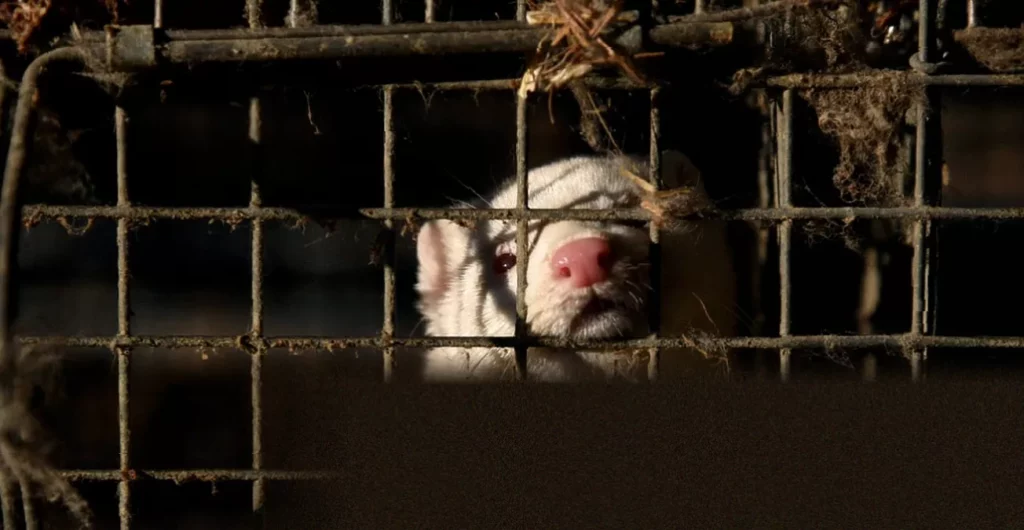
Fur farms pose a significant risk of incubating the next pandemic, yet the industry remains largely unregulated in many parts of the world – a dangerous gamble that public health experts say is no longer acceptable. The cramped, unsanitary conditions of these facilities create a perfect storm for viruses to emerge, mutate and spill back into human populations, with potentially catastrophic consequences.
How fur farms become viral incubators
The most common captive species on fur farms – mink – are what scientists describe as viral sponges. They are highly susceptible to respiratory pathogens from humans and other animals, and when thousands of inbred mink are packed into crowded, stressful settings, viruses spread like wildfire. With numerous opportunities to replicate, mutate and grow more dangerous, farming mink is essentially a dangerous genetic experiment conducted in the absence of necessary protective measures.
The risk is not hypothetical. In 2020, hundreds of people in Denmark – then the world’s fur-farming capital – fell ill with mink-related coronavirus strains. Health officials warned that continued mutation could jeopardise vaccine development, with one cautioning that Denmark could become “a new Wuhan”. The Danish government responded by ordering the slaughter of 17 million farmed mink, effectively wiping out the national industry. The compensation paid to Danish mink farmers – €3.2 billion – far exceeded the sector’s pre-crisis tax contribution.
Avian influenza (H5N1) has also been detected on European fur farms, raising alarms about mammal-to-mammal transmission and the potential for the virus to adapt to humans. Virologists at Imperial College London have urged the elimination of fur farming, especially mink farming, as a critical measure for pandemic preparedness. A study published in Nature identified 39 viruses on Chinese fur farms with a high risk of spreading to humans. The World Health Organization, the World Organisation for Animal Health and the Food and Agriculture Organization have all recognised the high public health risk of Covid-19 spillover from fur farming.
Hell on earth: the reality for farmed animals
Beyond the pandemic threat, the conditions on fur farms are inhumane by any standard. Animals are confined in tiny wire cages, often unable to move freely, living out their lives atop pools of their own waste. They are killed by gassing or electrocution, their pelts turned into coats worth thousands of pounds. Some species, like red foxes, begin chewing the tails off their young, or even killing them. Chinchillas tear out their own hair – a behaviour so common that some have explored mass-administering the antidepressant Prozac to the animals.
The European Food Safety Authority (EFSA) conducted an assessment of fur farming and concluded that, in most cases, “neither prevention nor substantial mitigation of the identified [welfare consequences] is possible in the current system”. In the United Kingdom, the Farm Animal Welfare Council (FAWC) previously concluded that fur farms could not meet the basic needs of animals – a judgment that contributed to the UK becoming one of the first countries to ban fur farming, in 2000 (England and Wales) and 2002 (Scotland and Northern Ireland). Austria followed in 2005.
A dying industry kept alive by taxpayers
Despite the documented risks and welfare failures, the fur industry has been kept on life support – largely by public money. The European Union was once a world-leading producer of farmed fur, but by 2024 the bloc’s thousand-odd farms produced a record-low six million pelts, generating just €180 million in sales – a figure comparable to the market for video and DVD rentals. Sales value has plummeted by 92% over the last decade. A report on the EU fur industry suggests it costs EU citizens €446 million annually due to environmental and public health costs that exceed its economic value.
European farmers now rely on government subsidies. In the United States, there are no federal regulations specifically governing the welfare of animals farmed for fur – the Animal Welfare Act explicitly exempts fur animals raised for their pelts. Last month, the House Committee on Agriculture advanced a version of the farm bill that would authorise taxpayer support to help domestic mink producers expand into international markets, though a 1996 spending bill provision previously prevented federal tax dollars from being used for marketing and promotion of mink fur. US domestic mink production has already shrunk to about 770,000 pelts a year, produced by fewer than 70 farms – down roughly 80% since 2015. A federal bill called the Mink Virus Act (also referred to as the MINKS are Superspreaders Act) would phase out mink farming within a year and compensate farmers for the full value of their operations.
Policy crossroads: bans versus business as usual
Globally, more than 30 countries have implemented bans on fur farming or prohibited the farming of specific species. Within the European Union, 18 member states have so far restricted fur farming, including Poland – once the continent’s top producer – which in December 2025 passed a ban with a phase-out period until 2033. Other European nations with recent or upcoming bans include Lithuania (2027), Latvia (2028), Ireland (March 2022), France (2021), Guernsey (2024), Norway (2025) and Hungary (which banned mink farming in November 2020).
In 2023, 1.5 million citizens petitioned the European Commission through a European Citizens’ Initiative called “Fur Free Europe” to enact a continent-wide ban on the production and sale of fur. But the Commission has delayed issuing a decision that was supposed to be released last month after years of deliberation. Leaked internal communications indicate that the European Commissioner for Health and Animal Welfare, Olivér Várhelyi, plans to reject it entirely due to economic concerns, favouring instead a weaker slate of reforms desired by the fur industry. A study of EU Commissioner meetings revealed a significantly higher access rate for industry representatives compared to animal welfare NGOs. The industry employs only a couple of thousand workers across the bloc – a number that could be fairly compensated and supported through a transition period.
In the United States, state-level initiatives are gaining ground. California banned fur sales in 2019, and New York – now the US’s largest fur market – has introduced legislation that would follow suit. Yet the US remains one of the world’s largest importers of fur, and despite the UK’s domestic ban, the country continues to import millions of pounds worth of fur products annually. A private member’s bill to ban fur imports and sales has been introduced in the UK, where over 96% of respondents to a 2021 government call for evidence agreed that killing animals for fur is wrong.
Practices once considered normal – such as force-feeding geese through a tube to grind their fatty livers into foie gras – are increasingly viewed as disgraceful relics of the past. Every US state treats the intentional killing of dogs and cats as a felony. The industrial-scale abuse of other mammals in the name of luxury, especially when it poses a catastrophic threat to society, is a contradiction that can no longer be ignored.