

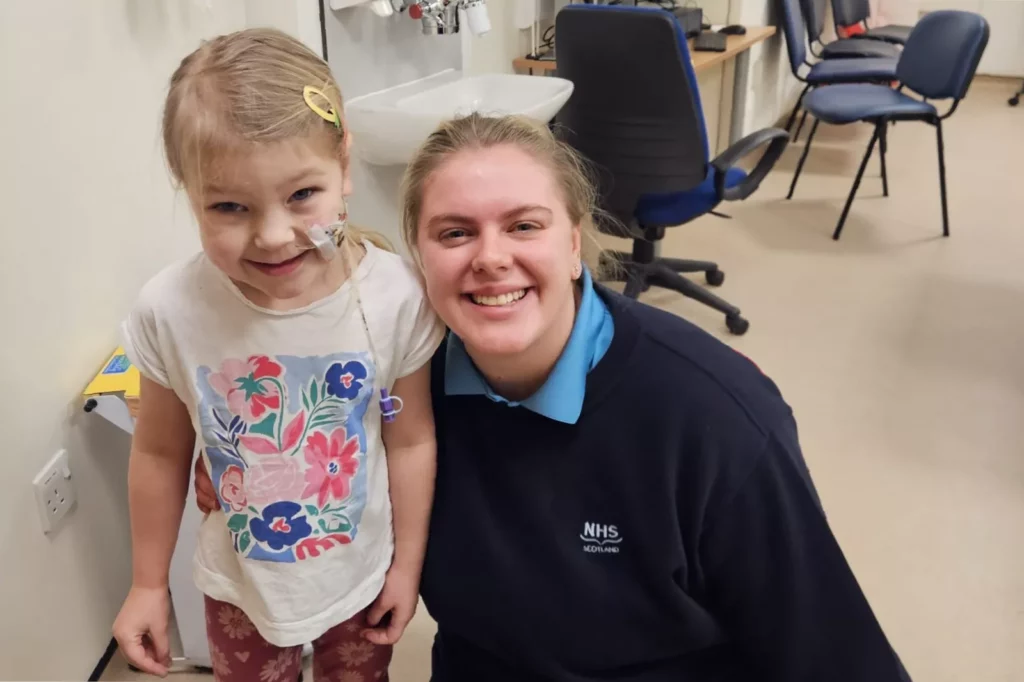
A four-year-old girl has regained her ability to move and speak after a life-saving brain tumour operation, her mother has said, describing the transformation as “incredible”. Jessica Macrae, from Bearsden in East Dunbartonshire, now walks with stability, feeds herself and talks freely – a recovery her parents feared might never happen when she was diagnosed last year.
Jessica is looking forward to celebrating her fifth birthday next month with a trip to a farm park with her cousins, a milestone that seemed impossible only six months ago. Her mother, Jude Pender, said: “Jessica is such a happy little girl and has shown incredible resilience and determination. She knows she has been unwell, but I don’t think she realises just how far she has come. We are so incredibly grateful to the teams who cared for her.”
A devastating diagnosis
The first signs of trouble emerged last summer. Ms Pender, 40, and her husband Andrew Macrae, 43, noticed “worrying changes” in their daughter’s health. “What started as headaches and feeling sick in the mornings gradually progressed to problems with balance and coordination,” Ms Pender said. “It was very incremental, but there were lots of things that didn’t feel right. Her colouring in went from being fine for her age to very messy, she disengaged from gymnastics because she said it made her dizzy, and I noticed her walk had changed.”
After an initial visit to Accident and Emergency in August and several GP appointments, Jessica’s symptoms worsened significantly, prompting her parents to return to the Royal Hospital for Children (RHC) in Glasgow in October. A CT scan revealed a mass at the back of her brain, accompanied by a concerning build-up of fluid. “When the neurosurgeon came to speak to us, we knew it was serious,” Ms Pender said. “We were told Jessica would need surgery immediately.”
Jessica underwent surgery on 17 October. Following a short stay in intensive care, she was transferred to a ward. But her recovery was initially extremely challenging. She displayed little movement or responsiveness and suffered severe sickness, leading medics to fit a “shunt” to drain excess fluid. Although she began to stabilise, she was unable to move or speak, required a feeding tube and needed full assistance from two staff members for any movement.
“The neurosurgeons did a great job with Jessica to get her to that point, and we are so grateful to them for saving her life,” Ms Pender said. “We also knew that it would take a team following the surgery to progress her movement, but we were never sure what the outcome would be.”
‘Fast-tracking a baby’s development’
That team came from the RHC’s physiotherapy department, which delivered a 12-week intensive neuro-rehabilitation programme that Ms Pender credits with transforming her daughter’s life. Jessica spent 13 weeks in hospital, during which she received daily physiotherapy sessions at her bedside, in the sensory room, in the gym and in the hydrotherapy pool.
“At the beginning, her rehabilitation was like fast-tracking a baby’s development – learning to hold her head up, sit, crawl, eat and walk again,” Ms Pender said. The programme was tailored to Jessica’s interests by her main physiotherapist, Fiona Norval, a paediatric physiotherapist with NHS Greater Glasgow and Clyde. “They played games, set up obstacle courses and made everything feel fun. Jessica looked forward to her physio, and that made such a difference,” Ms Pender added.
The Royal Hospital for Children, Scotland’s largest teaching paediatric hospital, is a major centre for paediatric neurosurgery, providing 24-hour consultant-led care for children across the country. Its paediatric intensive care unit (PICU) and dedicated parent accommodation at Crossbasket House allowed Jessica’s family to remain close throughout her treatment. The multidisciplinary approach – combining surgeons, nurses, physiotherapists and other specialists – was critical to her recovery, a model that experts say is particularly effective for young children, whose developing brains benefit from neuroplasticity and respond well to intensive rehabilitation.
Fiona Norval said Jessica’s determination throughout her recovery had been “incredible to see”. “Her rehabilitation was intensive and challenging, but she approached every session with curiosity and enthusiasm,” she said. “Our aim in paediatric physiotherapy is always to make therapy engaging and meaningful for the child, and Jessica’s progress is a testament to her hard work, her family’s support and the dedication of the wider multidisciplinary team involved in her care.”
Jessica was discharged in January and continues to improve. Her speech has returned, she is eating independently, her motor skills have “significantly improved” and she can now walk with greater stability and confidence. Her mother said the family’s gratitude extends to every member of the team who helped her daughter regain not just movement but the joy of childhood. “She knows she has been unwell,” Ms Pender said, “but I don’t think she realises just how far she has come.”